
Showing posts with label critical self reflection. Show all posts
Showing posts with label critical self reflection. Show all posts
Wednesday, April 4, 2018

Tuesday, November 14, 2017

We are regularly told that if we can just make our classes
more exciting, our students would be motivated to learn. While I have found
that to be true, I have also come to believe that using self-motivation and
critical self-reflection is vital for any student to really become what I would
call a super learner. This type of person wants to learn about new things because
they understand that it enhances their quality of life. While they do want to
get a great job (don't we all?) they know that hard work pays off and that
learning for the sake of being a better informed person can be motivation enough.
As I was going through my bookmark list, I found an article from 2013 that
validates my observations. “Boring but Important: A Self-Transcendent Purpose
for Learning Fosters Academic Self-Regulation”, is a paper that was published
based on research by David S. Yeager, Marlone D. Henderson, Sidney D’Mello,
David Paunesku, Gregory M. Walton, Brian J. Spitzer, and Angela Lee Duckworth.
They write, “Many important learning tasks feel uninteresting and tedious to
learners. This research proposed that promoting a pro-social, self-transcendent
purpose could improve academic self-regulation on such tasks. Results showed
that a self-transcendent purpose for learning increased the tendency to attempt
to deeply learn from the tedious academic task.” Because their research was
very extensive and actually included four studies, I strongly encourage you dive
into the article here.
Thursday, July 6, 2017

Wednesday, May 3, 2017

Tuesday, August 30, 2016
 Here is a great way to start your semester off right. Make a few resolutions and stick to them. We can always improve our teaching toolkit and David Gooblar shares his ideas in this article. I really like his suggestions and have adopted them for my class. Let me know what you think.
"When given a reading assignment, some students feel they have met their obligation if they have forced their eyes to ‘touch’ (in appropriate sequence) each word on the pages assigned. How can we entice students to read the material we assign, and how do we help them develop strategies for deep comprehension and retention of the material? Are there subtle ways we can prod them to read and help them develop literary skills—without spending our own precious time explicitly teaching ‘reading?" Find out in this article by Dr. Maryellen Weimer.
"I firmly believe that there is a direct correlation between what we expect of our students and what we get. We know that higher expectations generate greater learning. But we also know that higher expectations alone are not sufficient. Greater learning also results from support — support that can be provided, for example, by college-success courses in which common readings are often used." See what else Dr. John Gardner has to say about student success.
Thursday, August 11, 2016
Joshua Kim's post on where our focus should be in college classrooms is very insightful. Of the three recommendations he makes, I am happy to say we are actually working on all three. Not as efficiently as we could if we had more resources but nevertheless all three are foci. Kim writes, "Teaching and learning are core to the mission and operation of (almost) every college and university. An erosion of the relative quality in teaching and learning, (as compared to peer schools or emerging
competitors), will eventually result in an inability to compete for students, faculty, and funding." Continue reading here.
Ready for the semester to begin? No really, we are starting August 22. Did I just hear a few screams? The first day of the semester always seems to sneak up on us. Sims Wyeth has a good post on how we can increase the impact of our opening remarks. You know, the stuff you say every first day of class. It turns out that students form a really strong opinion of us on that first day and it may not change much over the course of the semester. He writes, "It turns out that our first impressions are not altogether accurate. Scientists call our tendency to leap to judgment the Fundamental Attribution Error. Nevertheless, as speakers, we can take advantage of this human frailty. When we step to the front of the room to deliver a presentation and all eyes are on us, we can take control using the tools at our disposal: physical, vocal, and verbal skills meant to capture the mind of the listener." Continue reading here.
Traditionally we make resolutions around the first of the year. But what if we made resolutions tied to each of our new semesters. Adjustments and corrections based on critical self-reflection are what I am talking about. David Gooblar provides us with a good start and writes, "The real new year in academe— the time for new beginnings and fresh starts — comes now, in August. I’ve had time away from the classroom to recharge my batteries and to forget about teaching for a while. I want to be a better teacher this year than I was last year. August is my month of big plans, of good intentions, of new leaves ready to be turned over." Continue reading here.
Tuesday, July 26, 2016
 Joshua Kim asks, "Is there really a war on lecturing going on across higher ed? Do learning professionals want to kill the lecture? Read Christine Gross-Loh’s Atlantic piece, Should Colleges Really Eliminate the College Lecture?, and you would be forgiven in thinking that there is and that we do. The anti-lecture cadre is characterized as comparing the traditional lecture to "bloodletting—an outdated practice that has long been in need of radical reform". This story makes for a neat argument. Who has not experienced the
power of a transformative lecture? Who would not support the need for
professors to “model the art of argument”? And who is not critical of the tendency of educational pundits and administrators to blindly follow the latest educational fads? Let me be very clear. There exists no campaign - no organized plot
or plan - to eliminate the college lecture. There is a movement across
many schools to improve learning. The lecture is, and always will be,
part of the mix of a rich and varied learning ecosystem." Continue reading here.
Now that you’ve finished assessing your students, it’s time to turn the assessment process around by looking in the mirror. If you limped across the finish line last semester, it may be time to identify some new strategies for self-care. In our “Tending the Teacher” session at the recent Teaching Professor Conference in Washington, D.C., we presented a menu of ideas to help faculty design a balanced and productive work life. Here are our top tips.
Aubree Evans writes, "Let’s face it, most faculty were good students and always did well in school. For students, having a professor who is adept at learning can be inspiring. But what if academic work comes so naturally to faculty that they have trouble relating to the average student? I’ve worked with several faculty members who fall into this category. “Rose,” a business professor, stands out in my memory. When I suggested that she break her online course into modules to make the weekly tasks more manageable for students, she was baffled. “Everything is in the syllabus!” she responded. She then explained that when she was in college, she began each course by carefully reading the syllabus and organizing the assignments into a schedule that she diligently followed throughout the semester. It didn’t make sense to Rose to repeat that information again in modules. When I suggested that school must have come easily to her, she agreed. However, our university serves many students who don’t have much experience with academic learning strategies that may come naturally to faculty." Continue reading here.
Wednesday, April 13, 2016

Dr. Maryellen Weimer gives us some ideas for the last class of the semester. She writes, "First and last class sessions are the bookends that hold a course together.” I heard or read that somewhere—apologies to the source I can’t acknowledge. It’s a nice way to think about first and last class sessions. In general, teachers probably do better with the first class. There’s the excitement that comes with a new beginning. A colleague said it this way: “Nothing bad has happened yet.” Most of us work hard to make good first impressions. But by the time the last class rolls around, everyone is tired, everything is due, and the course sputters to an end amid an array of last-minute details. Here are a few ideas that might help us finish the semester with the same energy and focus we mustered for the first class." Continue reading here.
ARE YOUR STUDENTS GRITTY
Before she was a psychologist at the University of Pennsylvania, Dr. Angela Duckworth was a middle school math teacher. As a rookie teacher, she was surprised when she calculated grades. Some of her sharpest students weren't doing so well, while others who struggled through each lesson were getting A's. "The thing that was revelatory to me was not that effort matters—everybody knows that effort matters," Angela told Shankar. "What was revelatory to me was how much it matters." Read more about the power and problem of grit here.
CARING THAT OUR STUDENTS LEARN
At this time of the semester, our attention turns to finals, projects, and the inevitable student ratings. Dr. Stephen Burt, a professor of English at Harvard University, explains how he has come to see the value in this ritual. He writes, "O wad some Pow’r the giftie gie us/ To see oursels as others see us!” Robert Burns wrote, in a poem with a thick Scottish accent. “It wad frae manie a blunder free us.” That power lies in student evaluations. They have obvious flaws, and all college teachers know how they can be misused—but colleges, and instructors, do better with them than without them. They can free teachers from blunders as well as flatter our self-regard, they remind us that if we care what our students learn, we ought to care about what they think; anonymous evaluations are one of the few ways that we can try to find out. Read the entire post here.
Wednesday, February 10, 2016
CREATING SELF-REGULATED LEARNERS
While the first faculty learning community of the spring semester has started meeting, there is still time to sign up for the second FLC that will begin to meet on Tuesday, February 16 at 2 pm. The topic is how we, as instructors, can create self-regulated learners. Dr. Linda Nilson defines a self-regulated learner as a student who is an intentional, independent, self-directed learner who can acquire, retain, and retrieve new knowledge on their own. The FLC will meet for eight sessions over the semester and finish on April 17. If you are interested in joining this FLC, please contact Barbara Linder.
HOW TO LIVE WISELY
Speaking of independent students, one of the best ways to get your students to improve is to spend a little time asking them to think about their thinking. How do they think they learn best? What are the things they have learned about themselves since they started attending college? Richard Light wrote a great story about a process he has used that appears to be a survey of student's wants and needs but ingenuously creates an environment that promotes critical self-reflection. He offers a number of conversation starters and activities that you can use to help your students through this process.
MAKE A CLEAR PATH
Helping under-prepared adult students earn a degree in a STEM discipline can be difficult without the added stressors of work and family commitment. But that is just what the folks in Texas' Rio Grande Valley are doing with a new bachelor's program in biomedical sciences. Because of their urgent need for medical professionals in an area that includes two of the three poorest counties in Texas, the local institution knew they had to respond with something different. Take a look at Steven Mintz's story from Inside Higher Ed.
Wednesday, December 16, 2015
COMING BACK FOR MORE
Dr. Maryellen Weimer has posted a terrific message on her blog about critical self-reflection. She writes, "When are you going to retire?” “Why are you still working?” These are questions I’m asked regularly. Worried that the question is motivated by signs of diminished mental acuity, I scour old and new writings looking for evidence. Should I stop working? I wonder. On a recent flight back to State College I sat next to a Penn State student, a junior accounting and finance major. She sounded like one of those students we’re only too happy to have in class. She talked about her courses, projects, assignments she was working on, her teachers, and how excited she was about her chosen fields. “And what do you do?” she asked. “Oh, I work for you,” I replied. “How so?” “Well, I work with college profs on ways to teach that help students learn.” “I’ve had quite a few teachers who could use your help,” she observed. “You know, a good teacher makes such a difference for students. I have this accounting prof who is just fantastic. I leave his class and I am so motivated. I do homework for that class first and I really study for his exams, and not just for the grade; I really want to learn the material.” “What’s his name?” I asked, and when she told me I felt a big smile crossing my face. “I know him! I helped him when he was a brand-new prof.” I didn’t tell her that he wasn’t a very good teacher back then. But I remember his commitment to doing better, his openness to suggestions, and his willingness to learn. And now he’s having this kind of impact on a student! I wish I’d had a glass of wine—a toast seemed so in order." Continue reading.
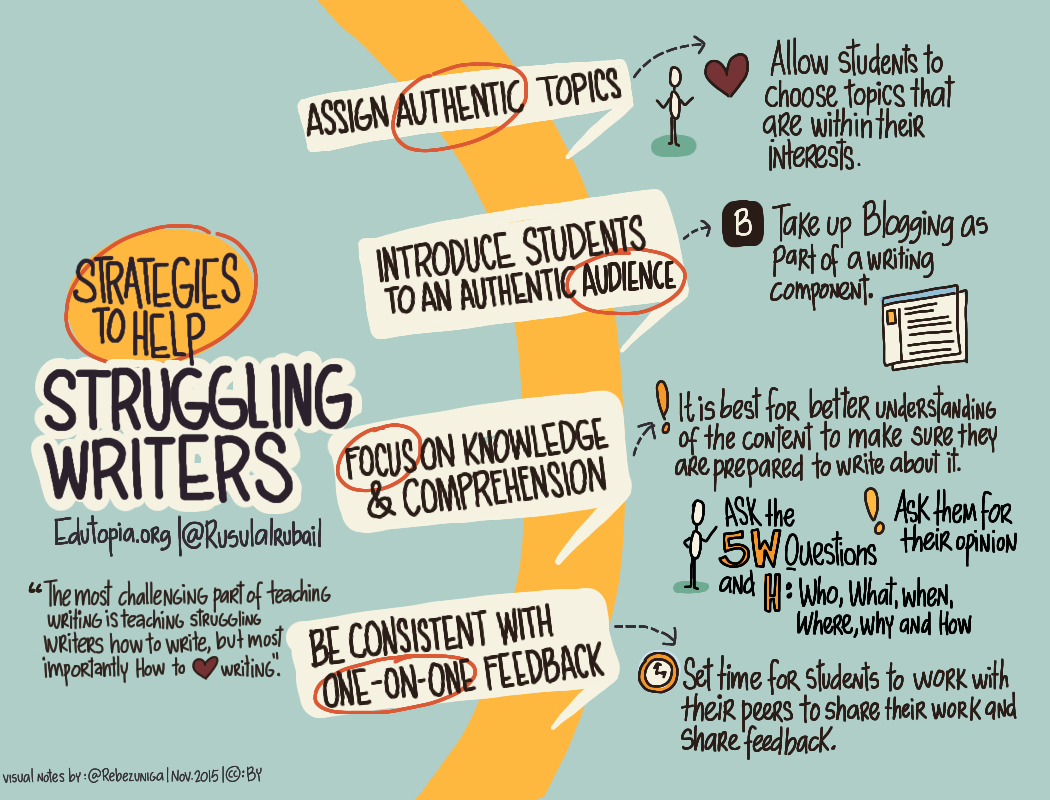
Love this graphic from Edutopia. It gets to the heart of learning experiences that focus on good writing.
HOW AM I GOING TO USE THIS IN REAL LIFE
The Idea Center offers us clear examples of how and why we should make our learning experiences relevant for our students. "There are many reasons for incorporating real-life situations into instruction. Foremost are that applications of theoretical material in real-life situations make content easier to understand, and that the relevance of content is demonstrated by real-life examples. Relevance is a major component of many motivational models (1, 2) and particularly important if learners’ experiences can be used as a basis for new learning. Recent literature on brain function and learning (3, 4) reinforces a constructivist view in which existing knowledge forms the foundation for incorporating new information into more complex and sophisticated schemas. Thus, if prior experience can be connected to new material in a meaningful way, that material can be more clearly understood and more easily learned." Continue reading.
Dr. Maryellen Weimer has posted a terrific message on her blog about critical self-reflection. She writes, "When are you going to retire?” “Why are you still working?” These are questions I’m asked regularly. Worried that the question is motivated by signs of diminished mental acuity, I scour old and new writings looking for evidence. Should I stop working? I wonder. On a recent flight back to State College I sat next to a Penn State student, a junior accounting and finance major. She sounded like one of those students we’re only too happy to have in class. She talked about her courses, projects, assignments she was working on, her teachers, and how excited she was about her chosen fields. “And what do you do?” she asked. “Oh, I work for you,” I replied. “How so?” “Well, I work with college profs on ways to teach that help students learn.” “I’ve had quite a few teachers who could use your help,” she observed. “You know, a good teacher makes such a difference for students. I have this accounting prof who is just fantastic. I leave his class and I am so motivated. I do homework for that class first and I really study for his exams, and not just for the grade; I really want to learn the material.” “What’s his name?” I asked, and when she told me I felt a big smile crossing my face. “I know him! I helped him when he was a brand-new prof.” I didn’t tell her that he wasn’t a very good teacher back then. But I remember his commitment to doing better, his openness to suggestions, and his willingness to learn. And now he’s having this kind of impact on a student! I wish I’d had a glass of wine—a toast seemed so in order." Continue reading.
Love this graphic from Edutopia. It gets to the heart of learning experiences that focus on good writing.
HOW AM I GOING TO USE THIS IN REAL LIFE
The Idea Center offers us clear examples of how and why we should make our learning experiences relevant for our students. "There are many reasons for incorporating real-life situations into instruction. Foremost are that applications of theoretical material in real-life situations make content easier to understand, and that the relevance of content is demonstrated by real-life examples. Relevance is a major component of many motivational models (1, 2) and particularly important if learners’ experiences can be used as a basis for new learning. Recent literature on brain function and learning (3, 4) reinforces a constructivist view in which existing knowledge forms the foundation for incorporating new information into more complex and sophisticated schemas. Thus, if prior experience can be connected to new material in a meaningful way, that material can be more clearly understood and more easily learned." Continue reading.
Wednesday, December 9, 2015

David J. Kujawski has written a good article explaining the basics of Present, Critique, Reflect, and Refine (PCRR) as a teaching strategy. Although he writes from a science background, the pedagogy of PCRR can be altered to accommodate any type of class. The method is especially useful for creating a culture of learning through argumentation. Kujawski writes, “The PCRR strategy promotes conceptual understanding of scientific phenomena in various disciplinary core ideas through the development of explanatory models that can later be applied to enrich student understanding and help explain other phenomena. [It also] develops an inquiry-driven, evidence-based mindset that supports model-based science teaching and three dimensional learning and assessment.” You can read more in his article “Present, Critique, Reflect, and Refine: Supporting Evidence-Based Argumentation Through Conceptual Modeling” that appears in Science Scope’s December 2015 issue.
COMPLETION BUILDS SELF EFFICACY
Rod, Risely, executive director of Phi Theta Kappa, released an op-ed piece about community college completion that presents a compelling case. He writes, "One has to wonder why, when the first community college was established in 1901 to provide access to higher education, completing college was not seen as integral to its mission. Clearly, today completion must be seen as central to the mission of our community colleges. To continue with our automotive analogy, it is a moral imperative that our institutions take responsibility for providing its consumers the tools and knowledge to “build a car” with the appropriate features that will lead them down a road toward economic prosperity and well-being. Community colleges must change their approach and accept responsibility for advising students upon enrollment on the importance of completing the associate degree prior to transferring to senior colleges. Studies show that community college students who transfer to senior colleges prior to earning the associate degree significantly increase their chances of never earning the baccalaureate degree."
LOOKING BACK TO PREPARE FOR THE FUTURE
David Gooblar urges us to encourage our students to be critically self-reflective about themselves and notes that the end of the semester is a great time to do it. He writes, "There are many reasons to have students complete self-evaluations at semester’s end, but perhaps the best is that the exercise encourages metacognition --- essentially “thinking about one’s thinking” — particularly in the context of getting students to consider their approach to our courses as they progress. But metacognition is a significantly valuable tool at the end of a course, when there are so many opportunities for self-reflection. At that point, students have been working on the same subject for more than three months; before they move on to other courses, and other professors, give them time and space to reflect on what they’ve done, and how they’ve done it. A self-evaluation is a great way to get students to assess how they approached the course with an eye to improving their learning strategies in the future. It can also help cement the particular skills they learned in your course — in effect, they remind themselves of the skills they’ve acquired, and may be more likely to put them to use in the future."
Friday, October 23, 2015

Boredom may be the largest pedagogical obstacle to teaching (Smith, 2007), and many believe it is up to teachers to spark students’ interest in classes. One way to ignite students’ enthusiasm is by using humor. In the classroom, humor can create a cheerful learning climate, enhance social bonding through increased student-instructor interaction, add variety to lectures, decrease test anxiety, and provide enjoyment and laughter. In addition to the social benefits, humor is cognitively and pedagogically important. For instance, instructional humor has been touted as an excellent way for students to learn
vocabulary, increase critical thinking, practice semantics, and remember more information. Because humor often plays with meaning, it helps individuals change their current mental perspective by visualizing problems in an alternate way, as well as engaging their critical thinking. In a study by Jana Hackathorn, Amy M. Garczynski, Katheryn Blankmeyer, Rachel D. Tennial, and Erin D. Solomon, results indicated that using humor to teach material significantly increased students’ overall performance on exams, particularly on knowledge and comprehension level quiz items, but not application level items. Moreover, learning a construct through the use of humor was most effective for comprehension level quiz items. Continue reading this article here.
EARLY COLLEGE HIGH SCHOOLS
Have you heard about the move afoot to turn high schools into college? Usually called early college high schools, they are growing in numbers due mainly to their success rates. Nationwide, 90 percent of early college students graduate from high school, 10 percentage points above the national average, and 30 percent of students get either an associate’s degree or a certificate, according to Jobs for the Future, the Boston-based nonprofit that runs the national Early College Designs program. Now, there are 280 early college schools nationwide – nearly 50 of which are in Texas. So far, the model has proven largely successful in graduating students from high school and introducing them to college courses. Most function like magnet schools, though, with students choosing to attend or even needing to apply. Continue reading this story here.
MENTORING OUR NEXT GROUP OF ENGAGED SCHOLARS
The BRCC Mentoring Program hosted the second meeting of the semester for the group of 14 Mentor/Mentee pairs yesterday. Our new faculty are reporting that having a mentor has improved their acclimation to teaching at BRCC and has greatly reduced their stress level. Topics during yesterday's session included student motivation, critical self-reflection, classroom management, and student retention. Participants also shared stories of what they have learned through their teaching experiences and how this continues to change and shape how they respond to their students. New faculty for fall 2015 include: Jennifer Bernard (Nursing), Matthew Buras (Mathematics), Danielle Burns (Art), Alexandra Cavazos (English), Tim Dykes (Construction Management), Zach Gasior (English), Darren Jones (Philosophy), Felecia McGhee (Surgical Technology), Lisa Namikas (History), Gregory Otto (Aviation), Priya Pathak (Chemistry), Pam Potter (Nursing), Jose Taj (Spanish), and Shena Williams (Nursing).
Friday, August 21, 2015
NEW SEMESTER BRINGS NEW HOPE
Another semester is about to begin and the bears are coming out of hibernation. I could add to your stress level by asking "are you ready?" I would rather help you make a smooth transition by giving you some resources that can help. There are a number of what to do during the first class/week suggestions here. I have also posted the latest version of our Active Learning Manual on the Canvas BRCC Teaching and Learning Faculty Development page. I sent an invitation for you to join that group on yesterday. If you have not accepted yet, you might want to take a minute to do that. Here is another tip sheet with some specific strategies you can use. This link includes videos that may be helpful to you.
 COMMITTMENT TO OUR CRAFT
We had a nice turnout for the Faculty Development Kickoff on Wednesday morning. Thanks again to all of you that took the time to hear about the latest brain and learning research. Critical self-reflection, journaling, and participating in professional development workshop are three of the best things you can do to continue to grow as an instructor. The Teaching+Learning Center provided over 80 hours of professional development opportunities last academic year. Our job as instructors is hard but if we expect out students to put in the effort and succeed, it is vitally important that we continue to learn as well. The PowerPoint from the session on Wednesday is on the Canvas BRCC Teaching and Learning Faculty Development page as well. I will be sending out an invitation soon to invite you to continue the discussion about the "team-teaching" initiative proposed by the Faculty Learning Committees that met over the spring and summer semesters.
 ADOPT A BEAR
For those who did not attend, I want to repeat the challenge I made at the Kickoff session. Please reach out to at least one student this semester and make them your priority. As instructors we are always concerned about all of our students but I am encouraging you to do something extra. Really commit to being an intrusive force for good in at least one student's life. Take the time to develop a deeper relationship with them. Be their advocate, coach, mentor, and source of irritation (if that is what is needed). If we all "adopt" one bear this semester, we will see a lot of those students return to us in the spring with a renewed sense of having been successful. Self-efficacy is a powerful motivator. Imagine what you can do!
Another semester is about to begin and the bears are coming out of hibernation. I could add to your stress level by asking "are you ready?" I would rather help you make a smooth transition by giving you some resources that can help. There are a number of what to do during the first class/week suggestions here. I have also posted the latest version of our Active Learning Manual on the Canvas BRCC Teaching and Learning Faculty Development page. I sent an invitation for you to join that group on yesterday. If you have not accepted yet, you might want to take a minute to do that. Here is another tip sheet with some specific strategies you can use. This link includes videos that may be helpful to you.

We had a nice turnout for the Faculty Development Kickoff on Wednesday morning. Thanks again to all of you that took the time to hear about the latest brain and learning research. Critical self-reflection, journaling, and participating in professional development workshop are three of the best things you can do to continue to grow as an instructor. The Teaching+Learning Center provided over 80 hours of professional development opportunities last academic year. Our job as instructors is hard but if we expect out students to put in the effort and succeed, it is vitally important that we continue to learn as well. The PowerPoint from the session on Wednesday is on the Canvas BRCC Teaching and Learning Faculty Development page as well. I will be sending out an invitation soon to invite you to continue the discussion about the "team-teaching" initiative proposed by the Faculty Learning Committees that met over the spring and summer semesters.
 ADOPT A BEAR
For those who did not attend, I want to repeat the challenge I made at the Kickoff session. Please reach out to at least one student this semester and make them your priority. As instructors we are always concerned about all of our students but I am encouraging you to do something extra. Really commit to being an intrusive force for good in at least one student's life. Take the time to develop a deeper relationship with them. Be their advocate, coach, mentor, and source of irritation (if that is what is needed). If we all "adopt" one bear this semester, we will see a lot of those students return to us in the spring with a renewed sense of having been successful. Self-efficacy is a powerful motivator. Imagine what you can do!
Monday, June 16, 2014
FINDING GOLD IN JERSEY
I am very excited to be one of the select few that will be heading to New Jersey to participate in Ken Bain's last Best Teachers Summer Institute later this week. Judging by the pre-conference homework (Dr. Bain's version of flipping), this promises to be an exceptional learning event. I wanted to share just a small sliver of what we are working on before coming together as a group. Dr. Bain has asked us to do some critical self-reflection (one of my favorite topics) and to specifically look at how we construct our syllabi. He asks, "how can a colleague develop a sense of you as a scholar by examining the various features of your course?" I hope that you do what I did when I saw that question and that is, quickly pull up one of your syllabi and begin to deconstruct it to determine the answer to this brilliant question. If our syllabi are truly the guiding documents for our partnerships with our students, shouldn't they reflect our teaching philosophy, our passion for the subject matter, and what we think is most important for student learning? In the same way, the assessment instruments we indicate on our syllabi are also telling an interesting story. I hope to bring back much more of this type of faculty development from the conference and am sure that our programming for the 2014-15 academic year will be shaped by what happens this week.
CRITICAL THINKING IN AN ONLINE ENVIRONMENT
Drs. S. Michael Putman, Karen Ford, and Susan Tancock have written an interesting article about enhancing critical thinking abilities using discussion boards in online classes. They write, "The asynchronous online discussion (AOD) is a communicative tool that has been observed to promote “a level of reflective interaction often lacking in a face-to-face, teacher-centered classroom.” Inherent within successful AODs is the use of meaningful discourse to facilitate critical engagement with the content that is the focus of the experience. Numerous studies have shown that effective AODS produce an increased level of cognitive thinking and knowledge construction within participants. Potential for these outcomes were maximized when learning objectives were linked to real-life experiences within moderately complex tasks. Participants in the AODs were more effectively able to understand the applicability of the content within the greater context of learning. Knowledge development increased as participants shared information regarding their beliefs and experiences. Critically engaging with and reflecting on content prior to sharing was theorized to account for differences." They encourage the use of "facilitative Prompts" to fully realize the effects of online discussion.
BOREDOM BLOCKERS
Boredom is one of the most common complaints among university students, with studies suggesting its link to poor grades, drop out, and behavioral problems according to an article by Drs. Steven J. Kass, Stephen J. Vodanovich, and Jasmine Y. Khosrav. They note that "Boredom proneness was found to be significantly and negatively related to course grade and measures of satisfaction." They conclude that "students need and desire the opportunity to use the variety of skills learned in class. Putting these skills into practice allows students to see the connection between what they learned and the context within which it is applied , thus increasing satisfaction and internal motivation which they may demonstrate through greater class attendance and engagement. Students may also benefit by allowing them to make their own decisions and develop individualized approaches (i.e., autonomy) to completing coursework. Consistent with many different theories on training and learning, students must be provided with in formative feedback to help direct efforts toward accomplishing their goals." Certainly another reason to look at experiential learning and the use of problem-based situations in our courses.
Thursday, May 9, 2013
CAN MY CLICKER TALK TO BLACKBOARD
The use of student response systems has been around for a number of years but the folks who provide the technology have not stopped trying to improve their effectiveness. Yesterday the Teaching+Learning Center hosted Paul King of Turning Technologies to share the latest on his version of "clickers." He was joined by Bill Joyce, who many at BRCC may remember as he was our "rep" for a number of years. The main updates focused on analytics. As with all technology, the tool only benefits us if it helps to improve teaching and learning and lightens the workload. When the conversation turned to how Turning Technologies products "talked" with our current version of Blackboard, those in attendance found out that there may indeed be some benefits to adopting the latest versions. At the end of the day we decided to continue talking with all the stakeholders to see how we can improve student learning through the use of deeper assessment. Stay tuned to this blog for updates on the progress.
ELEARNING RELAUNCH CONTINUES
This has been an interesting semester for our eLearning Program. In January, we hired Susan Nealy to manage the eLearning enterprise. We also embarked on a relaunch project that included course redesign based on industry-standard benchmarks. As you will recall, the eLearning offerings for the spring 2013 semester were limited to 28 classes to allow for evaluation and assessment to take place in a controlled environment. As we approach the end of the first semester since the relaunch, we are busy with the assessment part of the project. Many of you are about to receive a survey that will allow us to capture valuable information for the next step in the process. We are most interested in the student experience of this relaunch and will be surveying them as well. All of this is designed to provide our students with the best possible academic experience in an online environment. Student learning is still the main objective and we are optimistic that the changes being implemented will allow BRCC to provide a quality program of excellence.
EVERYBODY MULTITASKS BUT NOT VERY WELL
Larry Rosen, a psychology professor at California State University-Dominguez Hills, has published some interesting research on a topic near to my own areas of interest. His study takes a look at the use of technology during learning experiences, an idea that emerged from his book Rewired. He based his idea on the fact that students are experiencing multiple streams of information and entertainment while they study, do homework, or even sit in class. In fact, we know that this has become so common that most students rarely write a paper or complete a problem set without multitasking (or switch tasking as many psychologists have come to describe it). The evidence clearly shows that when students switch task while doing schoolwork, their learning is far spottier and shallower than if the work had their full attention. They understand and remember less, and they have greater difficulty transferring their learning to new contexts. Rosen suggests that we ask our students to take "tech breaks" during class. He gives them a chance to look at email and websites during class in short spurts throughout the class as long as they adhere to his rules during the class. Rosen has found that this will allow the students to build their resistance and begin to work longer periods without the tech breaks.
STAND AND DELIVER
Here is another suggestion from Dr. Dakin Burdick for an end of the semester activity that will provide you with great immediate feedback from your students about their experience in your class. Christopher Uhl recommends ending the course with an invitation to students to stand and share their thoughts. Some prompts for this exposition are emotional in nature: What are your regrets? How did you fail to live up to your potential? For what are you thankful? What are your hopes for yourself and for your colleagues? Others are challenges to the student to commit him/herself towards change: How will you use what you have learned? How do you resolve to change?
Thursday, December 6, 2012
DEEP LEARNING AND THE BRAIN
Skip Downing, creator of the massively successful On Course student success course, notes that there are three principles of deep learning. The first is prior learning. That is why it is important for us as teachers to relate new information for our students to previously learned information. Brain research reveals that when you connect what you are learning now to previously stored information, you learn the new information or skill faster and more deeply.The second, quality of processing, refers to using numerous and varied deep-processing strategies. Much of what we teach in college is too complex for mere memorization and calls for deep processing. The third is quantity of processing. This requires using frequent practice sessions of sufficient length distributed over time because the quality of learning is significantly affected by how often and how long someone engages in varied deep processing. You can learn more by visiting Downing's website.
Skip Downing, creator of the massively successful On Course student success course, notes that there are three principles of deep learning. The first is prior learning. That is why it is important for us as teachers to relate new information for our students to previously learned information. Brain research reveals that when you connect what you are learning now to previously stored information, you learn the new information or skill faster and more deeply.The second, quality of processing, refers to using numerous and varied deep-processing strategies. Much of what we teach in college is too complex for mere memorization and calls for deep processing. The third is quantity of processing. This requires using frequent practice sessions of sufficient length distributed over time because the quality of learning is significantly affected by how often and how long someone engages in varied deep processing. You can learn more by visiting Downing's website.
ASSESSING THE ASSESSMENT
The Association for the Assessment of Learning in Higher
Education (AALHE) is now accepting proposals for presentations at its third annual
conference. The AALHE 2013 conference theme is “Juggling Conflicting
Priorities: Rethinking What We Thought." How we can deal with existing and
emerging challenges while seizing new opportunities to create more meaningful
systems of assessment focused on improving learning is the central theme of the conference, which will be held in Lexington, KY, on June 3-5,
2013. In AALHE’s continuing effort to
provide a robust and transformative experience for conference attendees, they are
offering a wide variety of session formats this year. From standard concurrent
sessions to one-on-one consultations with assessment experts, assessment
practitioners attending the conference will have diverse
opportunities to will allow us to develop skills and strategies for improving assessment
at BRCC. Proposals are due by February 8, 2013. Visit the AALHE
website for more information.
GETTING WHAT YOU PAY FOR
Aaron Bady has written an interesting blog post about the value of MOOCs. He asks, "Why have we stopped aspiring to provide the real thing for everyone?" And adds, "MOOCs are only better than nothing and speculation that this will
someday change is worth pursuing, but for now, remains just that,
speculation. It should be no surprise that venture capital is interested
in speculation. And it should be no surprise that when academics look
at the actual track record, when we try to evaluate the evidence rather
than the hope, we discover a great deal to be pessimistic about."
CRITICAL SELF-REFLECTION IMPROVES TEACHING
Coming to the end of a semester always conjures up the inevitable wondering about having accomplished what you described in your learning objectives. Not simply "getting through the material" but really having your students learn. Lyons, Kysilka, and Pawlas (in their book The Adjunct Professor's Guide to Success LB1778.2.L96) tell us, "The instructor who regularly engages in systematic self-evaluation will unquestionably derive greater reward from the formal methods of evaluation commonly employed by colleges. Regular self-evaluation is especially important early in your career as you seek to develop insights and skills that will form habits you can incorporate into your continually evolving teaching style." It is just as important for those who have taught for a number years as it will help you uncover habits that are causing you problems in the classroom. I always recommend that you keep a journal for each class. This will allow you to reflect on your teaching experiences. Regularly investing 10-15 introspective minutes following each class meeting, noting what worked and what did not, will help you tremendously. Focus especially on the strategies and events in class that you feel could be improved. Jot down any breakthroughs, milestones, and disasters that occur over the course of the semester. Then commit to reading the comments before you begin to teach the same class again. This is especially useful if you are beginning a course redesign.
Subscribe to:
Posts (Atom)