HOW TO TEACH TO ALL YOUR STUDENTS
Dr. Matthew Wright has posted an article that is full of aha-moments. He writes, "Faculty members are generally happy to select out a few elite
students who they are confident can make it all the way to the top. For
these few bright and gifted students, the college experience becomes
almost otherworldly. They do research projects with their professors,
network with superstars in their field, travel to exotic locations, and
give papers at major conferences. Their professors become role models
and mentors who help them transition to greatness. But remember, most of the professors are elite folks themselves. You
have to be to make it through the maze that a typical professor endures
to get to the coveted tenure-track positions. So, essentially, you end
up with the top five percent of educated elites teaching to the top five
percent of elite students. That’s messed up." Keep reading here.
Showing posts with label learner-centered teaching. Show all posts
Showing posts with label learner-centered teaching. Show all posts
Monday, February 19, 2018
 Since we have learning objectives for each class we teach that correspond to broader course objectives, it is important to do a self check from time to time to make sure we are staying on track with both. Continuing to explore this topic, I have become more aware of alignment between the two in relation to my teaching. One of my course objectives is to help student to become better at critical thinking. Posing problems for them to solve and engaging them in group discussion while allowing for reflection time has created a truly active learning experience in my classroom. Lisa Nielsen's recent post about George Couros' book The Innovator’s Mindset provides a really clear visual for this process. Couros says that if we want innovative students, we must become innovative teachers. He goes on to list eight elements that he has noticed innovative teachers use to create this active learning environment that allows students to unleash their creativity. Continue reading here.
Wednesday, September 21, 2016
Foundational or “soft” skills occupy an unusual position in the debate over America’s workforce. Employers say these skills are hard to find, but they are also notoriously hard to define. Soft skills are called crucial and then treated dismissively in the next breath, as if these were abilities any child should have. “Works well with others” is a cliché on a school report card, but businesses grind to a halt when employees can’t meet deadlines, treat customers with
respect, or waste time scrambling to properly format a document. Take a look at what employers want in the full report.
Regardless
of their credentials, many freshmen doubt that they have the necessary brainpower or social adeptness to succeed in college. This fear of
failing hits poor, minority and first-generation college students
especially hard. If they flunk an exam, or a professor doesn’t call on
them, their fears about whether they belong may well be confirmed. The
cycle of doubt becomes self-reinforcing, and students are more likely to
drop out. The
good news is that this dismal script can be rewritten. Several recent
research projects show that, with the right nudge, students can acquire
ways of thinking that helps them thrive. Continue reading here.
Have you ever wondered if your students are as concerned about their
learning as you are? If you prioritize student learning, you may be the
only person in your classroom with that goal. Learning-centered teachers
seek to coauthor classroom experiences with their students, whereas
students may seek only to be taught passively. How might you inspire
your students to share accountability for their learning? These five
considerations can help you teach your students to be learning centered,
too. Continue reading here.
Wednesday, September 7, 2016

Larry Ferlazzo is an educationalist who strongly believes that we should be helping all students become self-regulated learners. In his new book Building a Community of Self-Motivated Learners: Strategies to Help Students Thrive in School and Beyond, he provides research on extrinsic and intrinsic motivation, and describes the four qualities that have been identified as critical to helping students motivate themselves: autonomy, competence, relatedness, and relevance. He says, "A high-quality relationship with a teacher whom they respect is a key element of helping students develop intrinsic motivation." Read more here.
Students who frequently check their grades throughout the semester tend to get better marks than do those who look less often. That’s one of the findings from a new study by Blackboard, a company that sells course-management software to hundreds of colleges. It’s probably one of the deepest data dives ever done on student clicks on college web systems, analyzing aggregate data from 70,000 courses at 927 colleges and universities in North America during the spring 2016 semester. The promise: Big data could lead to insights on how to keep struggling students on track, or at least let professors test their long-held assumptions about student habits. Read more here or listen to the podcast.
Tuesday, August 30, 2016
 Here is a great way to start your semester off right. Make a few resolutions and stick to them. We can always improve our teaching toolkit and David Gooblar shares his ideas in this article. I really like his suggestions and have adopted them for my class. Let me know what you think.
"When given a reading assignment, some students feel they have met their obligation if they have forced their eyes to ‘touch’ (in appropriate sequence) each word on the pages assigned. How can we entice students to read the material we assign, and how do we help them develop strategies for deep comprehension and retention of the material? Are there subtle ways we can prod them to read and help them develop literary skills—without spending our own precious time explicitly teaching ‘reading?" Find out in this article by Dr. Maryellen Weimer.
"I firmly believe that there is a direct correlation between what we expect of our students and what we get. We know that higher expectations generate greater learning. But we also know that higher expectations alone are not sufficient. Greater learning also results from support — support that can be provided, for example, by college-success courses in which common readings are often used." See what else Dr. John Gardner has to say about student success.
Thursday, August 11, 2016
Joshua Kim's post on where our focus should be in college classrooms is very insightful. Of the three recommendations he makes, I am happy to say we are actually working on all three. Not as efficiently as we could if we had more resources but nevertheless all three are foci. Kim writes, "Teaching and learning are core to the mission and operation of (almost) every college and university. An erosion of the relative quality in teaching and learning, (as compared to peer schools or emerging
competitors), will eventually result in an inability to compete for students, faculty, and funding." Continue reading here.
Ready for the semester to begin? No really, we are starting August 22. Did I just hear a few screams? The first day of the semester always seems to sneak up on us. Sims Wyeth has a good post on how we can increase the impact of our opening remarks. You know, the stuff you say every first day of class. It turns out that students form a really strong opinion of us on that first day and it may not change much over the course of the semester. He writes, "It turns out that our first impressions are not altogether accurate. Scientists call our tendency to leap to judgment the Fundamental Attribution Error. Nevertheless, as speakers, we can take advantage of this human frailty. When we step to the front of the room to deliver a presentation and all eyes are on us, we can take control using the tools at our disposal: physical, vocal, and verbal skills meant to capture the mind of the listener." Continue reading here.
Traditionally we make resolutions around the first of the year. But what if we made resolutions tied to each of our new semesters. Adjustments and corrections based on critical self-reflection are what I am talking about. David Gooblar provides us with a good start and writes, "The real new year in academe— the time for new beginnings and fresh starts — comes now, in August. I’ve had time away from the classroom to recharge my batteries and to forget about teaching for a while. I want to be a better teacher this year than I was last year. August is my month of big plans, of good intentions, of new leaves ready to be turned over." Continue reading here.
Ready for the semester to begin? No really, we are starting August 22. Did I just hear a few screams? The first day of the semester always seems to sneak up on us. Sims Wyeth has a good post on how we can increase the impact of our opening remarks. You know, the stuff you say every first day of class. It turns out that students form a really strong opinion of us on that first day and it may not change much over the course of the semester. He writes, "It turns out that our first impressions are not altogether accurate. Scientists call our tendency to leap to judgment the Fundamental Attribution Error. Nevertheless, as speakers, we can take advantage of this human frailty. When we step to the front of the room to deliver a presentation and all eyes are on us, we can take control using the tools at our disposal: physical, vocal, and verbal skills meant to capture the mind of the listener." Continue reading here.
Traditionally we make resolutions around the first of the year. But what if we made resolutions tied to each of our new semesters. Adjustments and corrections based on critical self-reflection are what I am talking about. David Gooblar provides us with a good start and writes, "The real new year in academe— the time for new beginnings and fresh starts — comes now, in August. I’ve had time away from the classroom to recharge my batteries and to forget about teaching for a while. I want to be a better teacher this year than I was last year. August is my month of big plans, of good intentions, of new leaves ready to be turned over." Continue reading here.
Tuesday, July 26, 2016
 Joshua Kim asks, "Is there really a war on lecturing going on across higher ed? Do learning professionals want to kill the lecture? Read Christine Gross-Loh’s Atlantic piece, Should Colleges Really Eliminate the College Lecture?, and you would be forgiven in thinking that there is and that we do. The anti-lecture cadre is characterized as comparing the traditional lecture to "bloodletting—an outdated practice that has long been in need of radical reform". This story makes for a neat argument. Who has not experienced the
power of a transformative lecture? Who would not support the need for
professors to “model the art of argument”? And who is not critical of the tendency of educational pundits and administrators to blindly follow the latest educational fads? Let me be very clear. There exists no campaign - no organized plot
or plan - to eliminate the college lecture. There is a movement across
many schools to improve learning. The lecture is, and always will be,
part of the mix of a rich and varied learning ecosystem." Continue reading here.
Joshua Kim asks, "Is there really a war on lecturing going on across higher ed? Do learning professionals want to kill the lecture? Read Christine Gross-Loh’s Atlantic piece, Should Colleges Really Eliminate the College Lecture?, and you would be forgiven in thinking that there is and that we do. The anti-lecture cadre is characterized as comparing the traditional lecture to "bloodletting—an outdated practice that has long been in need of radical reform". This story makes for a neat argument. Who has not experienced the
power of a transformative lecture? Who would not support the need for
professors to “model the art of argument”? And who is not critical of the tendency of educational pundits and administrators to blindly follow the latest educational fads? Let me be very clear. There exists no campaign - no organized plot
or plan - to eliminate the college lecture. There is a movement across
many schools to improve learning. The lecture is, and always will be,
part of the mix of a rich and varied learning ecosystem." Continue reading here.Now that you’ve finished assessing your students, it’s time to turn the assessment process around by looking in the mirror. If you limped across the finish line last semester, it may be time to identify some new strategies for self-care. In our “Tending the Teacher” session at the recent Teaching Professor Conference in Washington, D.C., we presented a menu of ideas to help faculty design a balanced and productive work life. Here are our top tips.
Aubree Evans writes, "Let’s face it, most faculty were good students and always did well in school. For students, having a professor who is adept at learning can be inspiring. But what if academic work comes so naturally to faculty that they have trouble relating to the average student? I’ve worked with several faculty members who fall into this category. “Rose,” a business professor, stands out in my memory. When I suggested that she break her online course into modules to make the weekly tasks more manageable for students, she was baffled. “Everything is in the syllabus!” she responded. She then explained that when she was in college, she began each course by carefully reading the syllabus and organizing the assignments into a schedule that she diligently followed throughout the semester. It didn’t make sense to Rose to repeat that information again in modules. When I suggested that school must have come easily to her, she agreed. However, our university serves many students who don’t have much experience with academic learning strategies that may come naturally to faculty." Continue reading here.
Wednesday, March 23, 2016
WORST LECTURE EVER
Amy Blanding, Kealin McCabe, and Heather Smith, PhD take a humorous approach to a learner-center teaching method called the Worst Lecture Competition. They write, "effective oral skills, well-designed presentations, and quality feedback are attributes that employers typically want from graduates. However, these skills are often expected to exist without appropriate support and training. Recognizing that public speaking often induces fear, a more positive, out-of-the-box approach could ease students into developing presentation skills. Regardless of personal perceptions regarding their own lecture proficiencies, students possess life experiences that give them the ability to evaluate the effectiveness of other presentations; sometimes they just need a prompt to acknowledge the value of their own experience. In addition to cultivating their own skills, it’s also essential for students to work on peer feedback skills. With these goals in mind, we created the Worst Lecture Competition" Read the entire post here.
DID YOU LISTEN TO THE TEXT
Would you like to add podcasts to your teaching toolkit? Michael Godsey has a helpful article that explains how he did just that. He writes, "I recently discovered my students voluntarily reading a story together, all at the same time. And they were inspired by an unlikely medium—podcasts—which is obviously ironic, as many people like podcasts precisely because they don’t have the time or inclination to sit down and read. In fact, Serial has an explicit warning at the beginning of their transcripts: Serial is produced for the ear and designed to be heard, not read. Of course, teenagers are infamous for enjoying exactly what they’re told not to do, but I was nevertheless surprised that while listening to an episode of Serial in class, their collective eyes fixed on the transcripts displayed on a screen at the front of the room. And I was startled—happily so—by their shouts when I was tardy in scrolling down." Read the entire article here.
REAL TIME CHECK ON LEARNING
Don't have time to check out a set of clickers from the Library? Still want to survey your students during class? You can use Google Forms instead. Dr. Michael J. LaGier writes, "As many educators are, I am interested in exploring methods that provide real-time, formative assessment in the classroom. Being a teacher of such courses as microbiology, microbial genomics, and immunology, which are dense in jargon and abstract concepts, I need to be able to quickly get a snapshot of how well my students are grasping important ideas or concepts. My students also need this information in order to assess their own learning. To this end, I started exploring the use of personal response systems, or clickers, as a method for rapid classroom assessment.Within Google Drive, I discovered an online survey tool called Google Forms. With Google Forms I am able to create surveys that my students can answer in real time, for free, using any device that is Wi-Fi compatible and has an Internet browser capable of running Google (smartphones, tablets, and laptops all work)." Learn how to do it here.
Amy Blanding, Kealin McCabe, and Heather Smith, PhD take a humorous approach to a learner-center teaching method called the Worst Lecture Competition. They write, "effective oral skills, well-designed presentations, and quality feedback are attributes that employers typically want from graduates. However, these skills are often expected to exist without appropriate support and training. Recognizing that public speaking often induces fear, a more positive, out-of-the-box approach could ease students into developing presentation skills. Regardless of personal perceptions regarding their own lecture proficiencies, students possess life experiences that give them the ability to evaluate the effectiveness of other presentations; sometimes they just need a prompt to acknowledge the value of their own experience. In addition to cultivating their own skills, it’s also essential for students to work on peer feedback skills. With these goals in mind, we created the Worst Lecture Competition" Read the entire post here.
DID YOU LISTEN TO THE TEXT
Would you like to add podcasts to your teaching toolkit? Michael Godsey has a helpful article that explains how he did just that. He writes, "I recently discovered my students voluntarily reading a story together, all at the same time. And they were inspired by an unlikely medium—podcasts—which is obviously ironic, as many people like podcasts precisely because they don’t have the time or inclination to sit down and read. In fact, Serial has an explicit warning at the beginning of their transcripts: Serial is produced for the ear and designed to be heard, not read. Of course, teenagers are infamous for enjoying exactly what they’re told not to do, but I was nevertheless surprised that while listening to an episode of Serial in class, their collective eyes fixed on the transcripts displayed on a screen at the front of the room. And I was startled—happily so—by their shouts when I was tardy in scrolling down." Read the entire article here.
REAL TIME CHECK ON LEARNING
Don't have time to check out a set of clickers from the Library? Still want to survey your students during class? You can use Google Forms instead. Dr. Michael J. LaGier writes, "As many educators are, I am interested in exploring methods that provide real-time, formative assessment in the classroom. Being a teacher of such courses as microbiology, microbial genomics, and immunology, which are dense in jargon and abstract concepts, I need to be able to quickly get a snapshot of how well my students are grasping important ideas or concepts. My students also need this information in order to assess their own learning. To this end, I started exploring the use of personal response systems, or clickers, as a method for rapid classroom assessment.Within Google Drive, I discovered an online survey tool called Google Forms. With Google Forms I am able to create surveys that my students can answer in real time, for free, using any device that is Wi-Fi compatible and has an Internet browser capable of running Google (smartphones, tablets, and laptops all work)." Learn how to do it here.
Wednesday, March 9, 2016
CREATING DYNAMIC LECTURES
Over the last 25 years, traditional lectures have taken a beating often portrayed as bad pedagogy. While some of the criticism is warranted, there are ways you can take your lecture-based learning experience and infuse it with active learning methods that promote student success. That is what the upcoming faculty professional development session is all about on March 17. Come and hear about the latest research, like Linda Nilson's self-regulated learners approach, that you can use to deepen your students recall and learning. The session begins at 3:00 pm and will be held in the Teaching+Learning Center (311 Magnolia Building) at BRCC-Mid City. Register now.
MORE EFFORT CAN LEAD TO BETTER LEARNING
Effort and habit are instrumental to learning and writing, but they are often dimly lit in our grading systems according to Dr. Gary Hafer. He says that light needs to brighten with the help of new research and popular literature that highlight how essential habit, effort, and perseverance are to learning. "I’ve used an effort-aware grading system in my teaching for some time now, a B-grading contract that locks hardworking students into a minimum final grade of B. For grades rising above B, the quality of the writing is the focus (the product), but only for students who fulfill the contract (the process). I’ve become a proponent of the “Contract for B,” first proposed by Peter Elbow, because I like how it encourages students to experiment with their college writing in new and novel ways. As experts in our own disciplines, we can write stipulations of the contract to identify how and what we see prolific writers do in our disciplines. Even habits such as writing daily and talking about their writing in specific ways are tasks that students can achieve no matter their writing proficiency. Moreover, it’s important for students to read in the syllabus that 'any student who works really, really hard can achieve these tasks because they are habits that define a process.'”Continue reading his article here.
WE CAN'T IGNORE STUDENT'S REALITY
Joshua Block's latest post on the Edutopia blog reminds us to understand where our students have been before we help them to move forward. He writes, "At their best, schools and classrooms affirm the power of community and what it means to be human. Teaching is complex work, and the challenges make it all too easy for teachers to lose focus of a greater vision for students and for society. Celebrating the potential of young people and the power of democratic education also means acknowledging and understanding the different ways that our society falls short." Continue reading his post here.
Over the last 25 years, traditional lectures have taken a beating often portrayed as bad pedagogy. While some of the criticism is warranted, there are ways you can take your lecture-based learning experience and infuse it with active learning methods that promote student success. That is what the upcoming faculty professional development session is all about on March 17. Come and hear about the latest research, like Linda Nilson's self-regulated learners approach, that you can use to deepen your students recall and learning. The session begins at 3:00 pm and will be held in the Teaching+Learning Center (311 Magnolia Building) at BRCC-Mid City. Register now.
MORE EFFORT CAN LEAD TO BETTER LEARNING
Effort and habit are instrumental to learning and writing, but they are often dimly lit in our grading systems according to Dr. Gary Hafer. He says that light needs to brighten with the help of new research and popular literature that highlight how essential habit, effort, and perseverance are to learning. "I’ve used an effort-aware grading system in my teaching for some time now, a B-grading contract that locks hardworking students into a minimum final grade of B. For grades rising above B, the quality of the writing is the focus (the product), but only for students who fulfill the contract (the process). I’ve become a proponent of the “Contract for B,” first proposed by Peter Elbow, because I like how it encourages students to experiment with their college writing in new and novel ways. As experts in our own disciplines, we can write stipulations of the contract to identify how and what we see prolific writers do in our disciplines. Even habits such as writing daily and talking about their writing in specific ways are tasks that students can achieve no matter their writing proficiency. Moreover, it’s important for students to read in the syllabus that 'any student who works really, really hard can achieve these tasks because they are habits that define a process.'”Continue reading his article here.
WE CAN'T IGNORE STUDENT'S REALITY
Joshua Block's latest post on the Edutopia blog reminds us to understand where our students have been before we help them to move forward. He writes, "At their best, schools and classrooms affirm the power of community and what it means to be human. Teaching is complex work, and the challenges make it all too easy for teachers to lose focus of a greater vision for students and for society. Celebrating the potential of young people and the power of democratic education also means acknowledging and understanding the different ways that our society falls short." Continue reading his post here.
Tuesday, January 12, 2016
START SMALL AND SEE BIG CHANGES
In our transition from an instructor-oriented approach to becoming a learner-centered college, we have discussed the use of active learning methods quiet a bit in the past. One of the best ways to begin to add teaching methods that promote active learning is by making small changes. Asking a "big" question to begin your class is a great start. Not only does it allow you to connect that day's class with the past but you can also build for the future and link the knowledge to a student's everyday life. James Lang offers some other suggestions in an article in The Chronicle of Higher Education and I encourage you to take a look as you wade into the spring 2016 semester.
CAN WE TALK
Another key to encouraging active learning is to use teaching methods early in the semester to set a pattern that allows your students to become comfortable with this approach. Using class discussion fosters active learning but there are times when it is difficult to get our students to participate. Scott Ellman has compiled some useful suggestions on how we can create a classroom culture that encourages participation. One of the first suggestions is to start with a sentence completion exercise. You can read about that and more in his post.
READY TO START
If you are looking for an easy check-list on what your first day of class might look like in order to foster active learning, Dr. Maryellen Weimer has come up with a concise top five things to do. She suggests that we be personable and adds, "Yes, you are the professor, but you are also a person. Students know that you’re the one in charge and that you’re the one who enforces the rules.Teachers shouldn't come across as the big “heavy” who lightens up only if students understand and accept who has the authority. Students want to be taught by a professor but one who acts like a person." You can find the rest of the list on the BRCC Teaching and Learning Faculty Development group on Canvas posted in the Modules under Active Learning and Teaching.
In our transition from an instructor-oriented approach to becoming a learner-centered college, we have discussed the use of active learning methods quiet a bit in the past. One of the best ways to begin to add teaching methods that promote active learning is by making small changes. Asking a "big" question to begin your class is a great start. Not only does it allow you to connect that day's class with the past but you can also build for the future and link the knowledge to a student's everyday life. James Lang offers some other suggestions in an article in The Chronicle of Higher Education and I encourage you to take a look as you wade into the spring 2016 semester.
CAN WE TALK
Another key to encouraging active learning is to use teaching methods early in the semester to set a pattern that allows your students to become comfortable with this approach. Using class discussion fosters active learning but there are times when it is difficult to get our students to participate. Scott Ellman has compiled some useful suggestions on how we can create a classroom culture that encourages participation. One of the first suggestions is to start with a sentence completion exercise. You can read about that and more in his post.
READY TO START
If you are looking for an easy check-list on what your first day of class might look like in order to foster active learning, Dr. Maryellen Weimer has come up with a concise top five things to do. She suggests that we be personable and adds, "Yes, you are the professor, but you are also a person. Students know that you’re the one in charge and that you’re the one who enforces the rules.Teachers shouldn't come across as the big “heavy” who lightens up only if students understand and accept who has the authority. Students want to be taught by a professor but one who acts like a person." You can find the rest of the list on the BRCC Teaching and Learning Faculty Development group on Canvas posted in the Modules under Active Learning and Teaching.
Wednesday, December 16, 2015
COMING BACK FOR MORE
Dr. Maryellen Weimer has posted a terrific message on her blog about critical self-reflection. She writes, "When are you going to retire?” “Why are you still working?” These are questions I’m asked regularly. Worried that the question is motivated by signs of diminished mental acuity, I scour old and new writings looking for evidence. Should I stop working? I wonder. On a recent flight back to State College I sat next to a Penn State student, a junior accounting and finance major. She sounded like one of those students we’re only too happy to have in class. She talked about her courses, projects, assignments she was working on, her teachers, and how excited she was about her chosen fields. “And what do you do?” she asked. “Oh, I work for you,” I replied. “How so?” “Well, I work with college profs on ways to teach that help students learn.” “I’ve had quite a few teachers who could use your help,” she observed. “You know, a good teacher makes such a difference for students. I have this accounting prof who is just fantastic. I leave his class and I am so motivated. I do homework for that class first and I really study for his exams, and not just for the grade; I really want to learn the material.” “What’s his name?” I asked, and when she told me I felt a big smile crossing my face. “I know him! I helped him when he was a brand-new prof.” I didn’t tell her that he wasn’t a very good teacher back then. But I remember his commitment to doing better, his openness to suggestions, and his willingness to learn. And now he’s having this kind of impact on a student! I wish I’d had a glass of wine—a toast seemed so in order." Continue reading.
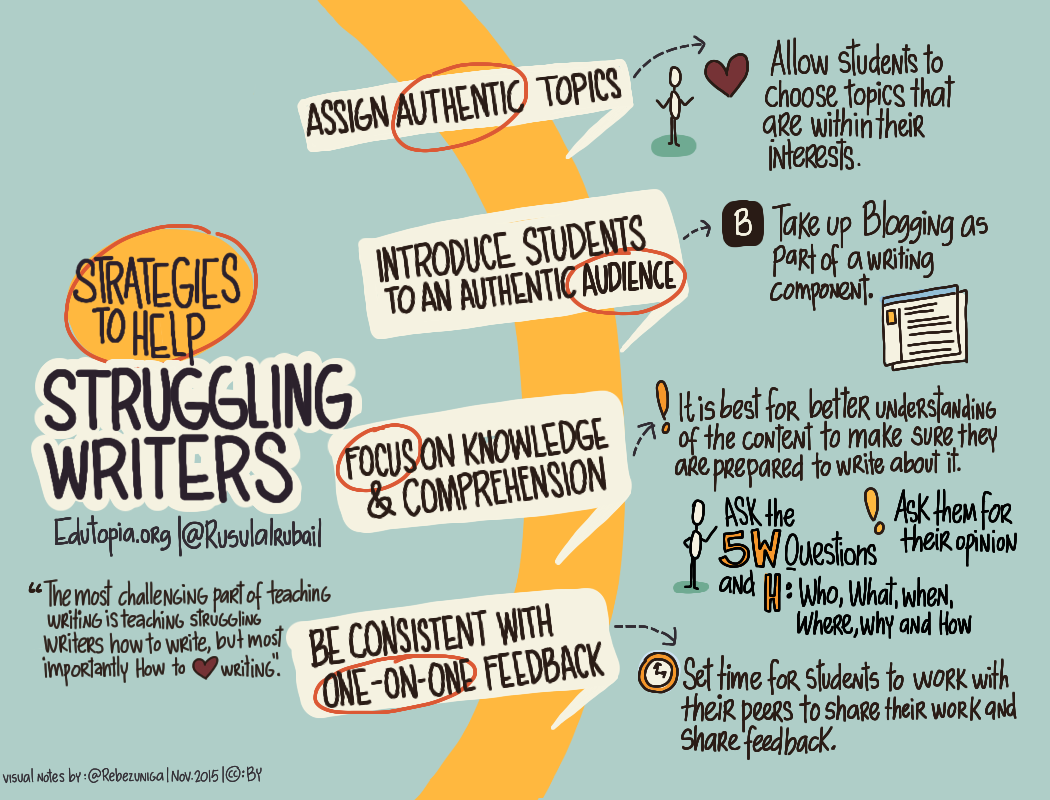
Love this graphic from Edutopia. It gets to the heart of learning experiences that focus on good writing.
HOW AM I GOING TO USE THIS IN REAL LIFE
The Idea Center offers us clear examples of how and why we should make our learning experiences relevant for our students. "There are many reasons for incorporating real-life situations into instruction. Foremost are that applications of theoretical material in real-life situations make content easier to understand, and that the relevance of content is demonstrated by real-life examples. Relevance is a major component of many motivational models (1, 2) and particularly important if learners’ experiences can be used as a basis for new learning. Recent literature on brain function and learning (3, 4) reinforces a constructivist view in which existing knowledge forms the foundation for incorporating new information into more complex and sophisticated schemas. Thus, if prior experience can be connected to new material in a meaningful way, that material can be more clearly understood and more easily learned." Continue reading.
Dr. Maryellen Weimer has posted a terrific message on her blog about critical self-reflection. She writes, "When are you going to retire?” “Why are you still working?” These are questions I’m asked regularly. Worried that the question is motivated by signs of diminished mental acuity, I scour old and new writings looking for evidence. Should I stop working? I wonder. On a recent flight back to State College I sat next to a Penn State student, a junior accounting and finance major. She sounded like one of those students we’re only too happy to have in class. She talked about her courses, projects, assignments she was working on, her teachers, and how excited she was about her chosen fields. “And what do you do?” she asked. “Oh, I work for you,” I replied. “How so?” “Well, I work with college profs on ways to teach that help students learn.” “I’ve had quite a few teachers who could use your help,” she observed. “You know, a good teacher makes such a difference for students. I have this accounting prof who is just fantastic. I leave his class and I am so motivated. I do homework for that class first and I really study for his exams, and not just for the grade; I really want to learn the material.” “What’s his name?” I asked, and when she told me I felt a big smile crossing my face. “I know him! I helped him when he was a brand-new prof.” I didn’t tell her that he wasn’t a very good teacher back then. But I remember his commitment to doing better, his openness to suggestions, and his willingness to learn. And now he’s having this kind of impact on a student! I wish I’d had a glass of wine—a toast seemed so in order." Continue reading.
Love this graphic from Edutopia. It gets to the heart of learning experiences that focus on good writing.
HOW AM I GOING TO USE THIS IN REAL LIFE
The Idea Center offers us clear examples of how and why we should make our learning experiences relevant for our students. "There are many reasons for incorporating real-life situations into instruction. Foremost are that applications of theoretical material in real-life situations make content easier to understand, and that the relevance of content is demonstrated by real-life examples. Relevance is a major component of many motivational models (1, 2) and particularly important if learners’ experiences can be used as a basis for new learning. Recent literature on brain function and learning (3, 4) reinforces a constructivist view in which existing knowledge forms the foundation for incorporating new information into more complex and sophisticated schemas. Thus, if prior experience can be connected to new material in a meaningful way, that material can be more clearly understood and more easily learned." Continue reading.
Thursday, December 3, 2015
THE ANSWERS ARE IN THE SYLLABUS
Now is a great time to begin to look at your syllabi for the spring semester. My colleague at George Mason's Center for Teaching and Faculty Excellence provides the following suggestions. At its most fundamental level, a course syllabus is essentially a contract between the instructor and the student and is a vital tool for communicating expectations between students and faculty. A well-constructed syllabus provides a road map for the course, answers frequently asked questions, can help to lessen student anxiety, and allows the faculty member to concentrate on instruction. At another level, though, a syllabus is the embodiment of your philosophy of teaching and learning. Implicit in every assignment, every choice of textbook, every discussion topic should be an indication of what you want your students to learn from your course and why you want them to learn it. Because critical thinking is at the heart of academic work, emphasize how your course will help them develop the kinds of skills with inquiry and problem solving that will benefit them throughout their time in college and into their lives as professionals. Continuing reading here.
GOING TO THE RESEARCH FOR SOLUTIONS
Dr. Maryellen Weimer’s latest post asks some really good questions about how we can use research to improve teaching and learning. She writes, “Evidence-based teaching seems like the new buzzword in higher education. The phrase appears to mean that we’ve identified and should be using those instructional practices shown empirically to enhance learning. Sounds pretty straightforward, but there are lots of questions that haven’t yet been addressed, such as: How much evidence does there need to be to justify a particular strategy, action, or approach? Is one study enough? What about when the evidence is mixed—in some studies the results of a practice are positive and in others they aren’t? In research conducted in classrooms, instructional strategies aren’t used in isolation; they are done in combination with other things. Does that grouping influence how individual strategies function?” Continue reading here.
THE GOOD OLD DAYS
Looking for some levity? Allison M. Vaillancourt’s latest post made me laugh while I was learning. She writes, “Who Melted My Cheese? would challenge the still-common worldview that academic life will eventually return to “normal” if we just sit patiently. According to that view, all the annoyances we are currently experiencing — state funding reductions, demands for accountability, and students who want their course content to be compelling — are simply fads that will soon fade if we just stay the course and insist on running our institutions like we did in the 1980s, or even the 1880s.” Continue reading here.
Now is a great time to begin to look at your syllabi for the spring semester. My colleague at George Mason's Center for Teaching and Faculty Excellence provides the following suggestions. At its most fundamental level, a course syllabus is essentially a contract between the instructor and the student and is a vital tool for communicating expectations between students and faculty. A well-constructed syllabus provides a road map for the course, answers frequently asked questions, can help to lessen student anxiety, and allows the faculty member to concentrate on instruction. At another level, though, a syllabus is the embodiment of your philosophy of teaching and learning. Implicit in every assignment, every choice of textbook, every discussion topic should be an indication of what you want your students to learn from your course and why you want them to learn it. Because critical thinking is at the heart of academic work, emphasize how your course will help them develop the kinds of skills with inquiry and problem solving that will benefit them throughout their time in college and into their lives as professionals. Continuing reading here.
GOING TO THE RESEARCH FOR SOLUTIONS
Dr. Maryellen Weimer’s latest post asks some really good questions about how we can use research to improve teaching and learning. She writes, “Evidence-based teaching seems like the new buzzword in higher education. The phrase appears to mean that we’ve identified and should be using those instructional practices shown empirically to enhance learning. Sounds pretty straightforward, but there are lots of questions that haven’t yet been addressed, such as: How much evidence does there need to be to justify a particular strategy, action, or approach? Is one study enough? What about when the evidence is mixed—in some studies the results of a practice are positive and in others they aren’t? In research conducted in classrooms, instructional strategies aren’t used in isolation; they are done in combination with other things. Does that grouping influence how individual strategies function?” Continue reading here.
THE GOOD OLD DAYS
Looking for some levity? Allison M. Vaillancourt’s latest post made me laugh while I was learning. She writes, “Who Melted My Cheese? would challenge the still-common worldview that academic life will eventually return to “normal” if we just sit patiently. According to that view, all the annoyances we are currently experiencing — state funding reductions, demands for accountability, and students who want their course content to be compelling — are simply fads that will soon fade if we just stay the course and insist on running our institutions like we did in the 1980s, or even the 1880s.” Continue reading here.
Wednesday, November 18, 2015
WHAT DOES A SUCCESSFUL STUDENT NEED TO KNOW
While we continue to offer a college success skills course, many of the students who would benefit most are not enrolling in the class. If you are advising a student who has struggled with time management, test anxiety, metacognition issues, critical thinking or any other issues that prevent their academic progress, it may be time to suggest they enroll in a CSSK 102 class. In the absence of taking that class, you should strongly encourage them to take advantage of the various workshops offered by the Academic Learning Center. Karp and Bork, of the Community College Research Center, have written a working paper on the topic. They note "While low college success rates are typically linked to students’ lack of academic preparation for college and their subsequent need for developmental or remedial instruction, research suggests that even many students who are deemed “college-ready” by virtue of their placement test scores or completion of developmental coursework still do not earn a credential." Their paper builds on previous work arguing that community college success is dependent not only upon academic preparation but also upon a host of important skills, attitudes, and behaviors that are often left unspoken. The paper clarifies the role of the community college student and the components of that role that must be enacted for students to be successful. They provide a concrete, actionable description of the community college student role and present a framework that practitioners can use to help students learn how to be successful community college students.
USING STUDENT RATING FEEDBACK EFFECTIVELY
As our students begin to complete their ratings of their experiences in our classes, it is a good time to take a look at how we as faculty can use the data and what the current research says about the process. Safavi and Bakar, et al. suggest that faculty may want to add some additional questions to the ratings in order to gather information more specific to their subject matter and teaching approach. In research performed by Slocombe, Miller, and Hite, they note that students tended to give higher evaluations to professors who used humor and to professors they liked but the difficulty of the class did not impact students' ratings of faculty. Ronald A. Berk's research revealed that students' expectations about how the results will be used are also critical to future response rates. Chen and Hoshower found that students’ motivation to participate in the rating system hinged on the following semi-observable outcomes (in order of decreasing importance): (1) improvements in teaching, (2) improvements in course content and format, and (3) faculty personnel decisions (promotion, tenure, salary increase).
BECOMING A LEARNER-CENTERED EDUCATOR
Dr. James Lang has written a column for The Chronicle of Higher Education about some of the small decisions he has made that had a big impact on his classes. He writes, "When I first started teaching, the open space of a 50- or 75-minute class period seemed an eternity. Like many a new faculty member, I worried about having enough material. I wanted to ensure that, if discussion faltered or if I rushed through the lecture too quickly, I would have options to fill the remaining time. My greatest fear was using up everything I had and finding 30 minutes still left on the clock. Twenty years later I seem to have the opposite problem: not enough time in the class period to accomplish everything I have planned. It seems so difficult to me now to do much of substance in 50 minutes. I don’t know whether to blame that shift in perspective on the fact that I have more teaching experience or that I’m just older. I suppose those two possibilities don’t untangle very easily." Continue reading here.
While we continue to offer a college success skills course, many of the students who would benefit most are not enrolling in the class. If you are advising a student who has struggled with time management, test anxiety, metacognition issues, critical thinking or any other issues that prevent their academic progress, it may be time to suggest they enroll in a CSSK 102 class. In the absence of taking that class, you should strongly encourage them to take advantage of the various workshops offered by the Academic Learning Center. Karp and Bork, of the Community College Research Center, have written a working paper on the topic. They note "While low college success rates are typically linked to students’ lack of academic preparation for college and their subsequent need for developmental or remedial instruction, research suggests that even many students who are deemed “college-ready” by virtue of their placement test scores or completion of developmental coursework still do not earn a credential." Their paper builds on previous work arguing that community college success is dependent not only upon academic preparation but also upon a host of important skills, attitudes, and behaviors that are often left unspoken. The paper clarifies the role of the community college student and the components of that role that must be enacted for students to be successful. They provide a concrete, actionable description of the community college student role and present a framework that practitioners can use to help students learn how to be successful community college students.
USING STUDENT RATING FEEDBACK EFFECTIVELY
As our students begin to complete their ratings of their experiences in our classes, it is a good time to take a look at how we as faculty can use the data and what the current research says about the process. Safavi and Bakar, et al. suggest that faculty may want to add some additional questions to the ratings in order to gather information more specific to their subject matter and teaching approach. In research performed by Slocombe, Miller, and Hite, they note that students tended to give higher evaluations to professors who used humor and to professors they liked but the difficulty of the class did not impact students' ratings of faculty. Ronald A. Berk's research revealed that students' expectations about how the results will be used are also critical to future response rates. Chen and Hoshower found that students’ motivation to participate in the rating system hinged on the following semi-observable outcomes (in order of decreasing importance): (1) improvements in teaching, (2) improvements in course content and format, and (3) faculty personnel decisions (promotion, tenure, salary increase).
BECOMING A LEARNER-CENTERED EDUCATOR
Dr. James Lang has written a column for The Chronicle of Higher Education about some of the small decisions he has made that had a big impact on his classes. He writes, "When I first started teaching, the open space of a 50- or 75-minute class period seemed an eternity. Like many a new faculty member, I worried about having enough material. I wanted to ensure that, if discussion faltered or if I rushed through the lecture too quickly, I would have options to fill the remaining time. My greatest fear was using up everything I had and finding 30 minutes still left on the clock. Twenty years later I seem to have the opposite problem: not enough time in the class period to accomplish everything I have planned. It seems so difficult to me now to do much of substance in 50 minutes. I don’t know whether to blame that shift in perspective on the fact that I have more teaching experience or that I’m just older. I suppose those two possibilities don’t untangle very easily." Continue reading here.
Wednesday, September 23, 2015
MISCOMMUNICATION, PERSONAL ATTACKS AND TROLLING
Adding a discussion component to your face-to-face or eLearning class is a great way to measure learning. The depth of a question can tell you plenty about where your students are along the learning spectrum. Having peer-to-peer discussions is also a great way to illustrate that students are part of the learning process and should not expect all of the answers to come directly from you. If you are thinking of adding discussions to your class, there are a few areas of concern that you should be prepared for and Anastasia Salter has written an article to help you out. She writes, "I’ve been teaching a large online class for the first time this semester, and as the course involves looking at a number of challenge interactive works and games I put a lot of emphasis on discussion forums and critical debate. However, discussion forums of this kind present a lot of potential problems in an online class. We only have to read the comments anywhere on the web (pro tip: don’t actually read the comments) to see that the online medium offers huge potential for miscommunication, personal attacks, trolling, and harassment–even when in the space of a virtual classroom." To see her tips click here.
THE PAIN OF AWKWARD SILENCE
Dr. Kenneth L. Parker, Steber Professor in Theological Studies at St. Louis University, has an interesting post today about asking students questions. He writes, "At the beginning of each academic year, I have to relearn the same lesson: enduring the awkward silence after a question has been asked. At the start of my career this “skill” seemed unendurable. It felt far easier to fill the empty void of fifty or seventy-five minutes—or God forbid, two and a half hours—with the sound of my own voice and well chosen words recorded on paper. After all, students are conditioned to expect that of my guild. Yet as I began to take more seriously the need to create learner-centered classroom experiences, one of the first steps to achieve that goal proved to be silencing my own voice, and waiting for students to find theirs. Continue reading
IS PESSIMISM HURTING STUDENT SUCCESS
Some of your students may be falling behind because they suffer from a negative disposition. Dr. Travis Bradberry provides us with interventions that can help create student success through positivity. He writes, "When faced with setbacks and challenges, we’ve all received the well-meaning advice to “stay positive.” The greater the challenge, the more this glass-half-full wisdom can come across as Pollyannaish and unrealistic. It’s hard to find the motivation to focus on the positive when positivity seems like nothing more than wishful thinking. The real obstacle to positivity is that our brains are hard-wired to look for and focus on threats. This survival mechanism served humankind well back when we were hunters and gatherers, living each day with the very real threat of being killed by someone or something in our immediate surroundings." Continue reading
Adding a discussion component to your face-to-face or eLearning class is a great way to measure learning. The depth of a question can tell you plenty about where your students are along the learning spectrum. Having peer-to-peer discussions is also a great way to illustrate that students are part of the learning process and should not expect all of the answers to come directly from you. If you are thinking of adding discussions to your class, there are a few areas of concern that you should be prepared for and Anastasia Salter has written an article to help you out. She writes, "I’ve been teaching a large online class for the first time this semester, and as the course involves looking at a number of challenge interactive works and games I put a lot of emphasis on discussion forums and critical debate. However, discussion forums of this kind present a lot of potential problems in an online class. We only have to read the comments anywhere on the web (pro tip: don’t actually read the comments) to see that the online medium offers huge potential for miscommunication, personal attacks, trolling, and harassment–even when in the space of a virtual classroom." To see her tips click here.
THE PAIN OF AWKWARD SILENCE
Dr. Kenneth L. Parker, Steber Professor in Theological Studies at St. Louis University, has an interesting post today about asking students questions. He writes, "At the beginning of each academic year, I have to relearn the same lesson: enduring the awkward silence after a question has been asked. At the start of my career this “skill” seemed unendurable. It felt far easier to fill the empty void of fifty or seventy-five minutes—or God forbid, two and a half hours—with the sound of my own voice and well chosen words recorded on paper. After all, students are conditioned to expect that of my guild. Yet as I began to take more seriously the need to create learner-centered classroom experiences, one of the first steps to achieve that goal proved to be silencing my own voice, and waiting for students to find theirs. Continue reading
IS PESSIMISM HURTING STUDENT SUCCESS
Some of your students may be falling behind because they suffer from a negative disposition. Dr. Travis Bradberry provides us with interventions that can help create student success through positivity. He writes, "When faced with setbacks and challenges, we’ve all received the well-meaning advice to “stay positive.” The greater the challenge, the more this glass-half-full wisdom can come across as Pollyannaish and unrealistic. It’s hard to find the motivation to focus on the positive when positivity seems like nothing more than wishful thinking. The real obstacle to positivity is that our brains are hard-wired to look for and focus on threats. This survival mechanism served humankind well back when we were hunters and gatherers, living each day with the very real threat of being killed by someone or something in our immediate surroundings." Continue reading
Wednesday, August 26, 2015

Shana Oliver has done an exceptional job of pulling together all of the best ideas that have emerged from the research about faculty and student engagement. The article provides a nice concise list of ten ways you can use to engage under-performing students. She writes, "What is the intended goal of the lesson? Remember, there is one essential question per lesson, and students must be able to answer this question by the end of the lesson. With essential questions, teachers really have to be intentional about what they want the students to be able to do, and it has to be at the highest-level of learning. The students have to be able to analyze and apply; they cannot just answer the question with a yes or no. It has to be an extended response. An essential question must be "multi-skill" in order for it to be a good one." To read the rest of the article, click here.
ADOPT A BEAR TIPS
If Santa Monica College had relied solely on data analytics to predict whether Jaime J. would succeed, the picture would have looked bleak. He was, after all, a financially struggling, first-generation Hispanic student who was juggling a job with classes. His math skills were shaky. But there was more to the picture than that. Using a 30-minute online assessment that focuses on noncognitive skills, advisers at the two-year institution in Southern California learned that Jaime was also a conscientious student with good study habits who had long dreamed of becoming a computer engineer. The college assigned him a success coach (the college’s dean of counseling and retention), who met with Jaime weekly to keep him motivated. Continue reading.
GRADING IS ABOUT LEARNING
When students talk about the grades we’ve “given” them, we are quick to point out that we don’t “give” grades, students “earn” them. And that’s correct. It’s what the student does that determines the grade. But that statement sort of implies that we don’t have much of a role in the process—that we’re simply executing what the grading policy prescribes. We shouldn’t let that response cloud our thinking. Who sets up the course grading policy? Who controls it? Who has the power to change it or to refuse to change it? It’s these policies that involve us up to our eyeballs. Continue reading.
Friday, August 21, 2015
NEW SEMESTER BRINGS NEW HOPE
Another semester is about to begin and the bears are coming out of hibernation. I could add to your stress level by asking "are you ready?" I would rather help you make a smooth transition by giving you some resources that can help. There are a number of what to do during the first class/week suggestions here. I have also posted the latest version of our Active Learning Manual on the Canvas BRCC Teaching and Learning Faculty Development page. I sent an invitation for you to join that group on yesterday. If you have not accepted yet, you might want to take a minute to do that. Here is another tip sheet with some specific strategies you can use. This link includes videos that may be helpful to you.
 COMMITTMENT TO OUR CRAFT
We had a nice turnout for the Faculty Development Kickoff on Wednesday morning. Thanks again to all of you that took the time to hear about the latest brain and learning research. Critical self-reflection, journaling, and participating in professional development workshop are three of the best things you can do to continue to grow as an instructor. The Teaching+Learning Center provided over 80 hours of professional development opportunities last academic year. Our job as instructors is hard but if we expect out students to put in the effort and succeed, it is vitally important that we continue to learn as well. The PowerPoint from the session on Wednesday is on the Canvas BRCC Teaching and Learning Faculty Development page as well. I will be sending out an invitation soon to invite you to continue the discussion about the "team-teaching" initiative proposed by the Faculty Learning Committees that met over the spring and summer semesters.
 ADOPT A BEAR
For those who did not attend, I want to repeat the challenge I made at the Kickoff session. Please reach out to at least one student this semester and make them your priority. As instructors we are always concerned about all of our students but I am encouraging you to do something extra. Really commit to being an intrusive force for good in at least one student's life. Take the time to develop a deeper relationship with them. Be their advocate, coach, mentor, and source of irritation (if that is what is needed). If we all "adopt" one bear this semester, we will see a lot of those students return to us in the spring with a renewed sense of having been successful. Self-efficacy is a powerful motivator. Imagine what you can do!
Another semester is about to begin and the bears are coming out of hibernation. I could add to your stress level by asking "are you ready?" I would rather help you make a smooth transition by giving you some resources that can help. There are a number of what to do during the first class/week suggestions here. I have also posted the latest version of our Active Learning Manual on the Canvas BRCC Teaching and Learning Faculty Development page. I sent an invitation for you to join that group on yesterday. If you have not accepted yet, you might want to take a minute to do that. Here is another tip sheet with some specific strategies you can use. This link includes videos that may be helpful to you.

We had a nice turnout for the Faculty Development Kickoff on Wednesday morning. Thanks again to all of you that took the time to hear about the latest brain and learning research. Critical self-reflection, journaling, and participating in professional development workshop are three of the best things you can do to continue to grow as an instructor. The Teaching+Learning Center provided over 80 hours of professional development opportunities last academic year. Our job as instructors is hard but if we expect out students to put in the effort and succeed, it is vitally important that we continue to learn as well. The PowerPoint from the session on Wednesday is on the Canvas BRCC Teaching and Learning Faculty Development page as well. I will be sending out an invitation soon to invite you to continue the discussion about the "team-teaching" initiative proposed by the Faculty Learning Committees that met over the spring and summer semesters.
 ADOPT A BEAR
For those who did not attend, I want to repeat the challenge I made at the Kickoff session. Please reach out to at least one student this semester and make them your priority. As instructors we are always concerned about all of our students but I am encouraging you to do something extra. Really commit to being an intrusive force for good in at least one student's life. Take the time to develop a deeper relationship with them. Be their advocate, coach, mentor, and source of irritation (if that is what is needed). If we all "adopt" one bear this semester, we will see a lot of those students return to us in the spring with a renewed sense of having been successful. Self-efficacy is a powerful motivator. Imagine what you can do!
Thursday, June 25, 2015
EVERYBODY IS GOING TO COMMUNITY COLLEGE
Did you know that the community colleges in the United States provide access to higher education for over 10 million students each year? Bailey, Jaggars, and Jenkins in their book Redesigning America's Community Colleges: A clearer path to student success say that because community colleges are designed to provide access to a wide variety of students with a wide variety of goals, community colleges give students many choices which may be one of the causes for low completion. But they don't just give us the gory details and horror stories, they also provide some paths for solutions. The Teaching and Learning 101 Faculty Learning Community is using this book along with material from other educational scientists during the summer session. Although FLCs are mainly professional development opportunities, the structure and focus often lead to new ideas, movements, or proposals that can lead to positive change for their institutions. If you are interested in learning more I encourage you to talk with one of the FLC members who include: Amy Atchley, Cristi Carson, Pearce Cinman, Cindy Decker, Christopher Guillory, Divina Miranda, Rhonda Picou, and Todd Pourciau. The FLC meets on Wednesdays at 1:00 pm in the Teaching+Learning Center.
MOVING FROM COVERAGE TO LEARNING
Dr. David Gooblar has written an interesting blog post about an issue that dogs many of us. The difference between covering all of the material versus helping students learn. I did say versus but it doesn't have to be that way. In fact, research shows that if we work to help our students become independent scholars who are interested in the subject at hand, the coverage can occur naturally. Goobler writes, "How do I balance my desire to integrate student-centered learning practices with my almost pathological need to have every last bit of the course planned out and thought through? Most of my pedagogy research has suggested that we as faculty should be looking for ways to give students a real sense of ownership in the classroom. One of our goals should be to create an atmosphere that leaves space for students take an active role in their own learning. How, then, do we design a course before even meeting our students? Isn’t there a danger in showing up to the first day of class with a syllabus that shows the whole course planned out? By doing so, aren't we clearly communicating to the students that the instructor is in charge, that if you know what’s good for you, you’ll follow these rules?"
FITNESS FOR THE BRAIN
Studies have consistently shown that when we exercise we are more aroused: there is increased blood flow to the brain, greater neurotransmitter secretion, and increased brain growth and plasticity over time. All of this improves our memory, attention spans, and executive functions like reasoning, problem solving, and planning. Our brains are alert and we experience a decrease in stress, which has proven to be a performance killer. So what am I telling you? Do I want you to have your students do a little physical activity in the classroom? Why not? That is what active learning is all about. Get your students to move around (group to group, pairing off, or going to the board) and see what happens.
Did you know that the community colleges in the United States provide access to higher education for over 10 million students each year? Bailey, Jaggars, and Jenkins in their book Redesigning America's Community Colleges: A clearer path to student success say that because community colleges are designed to provide access to a wide variety of students with a wide variety of goals, community colleges give students many choices which may be one of the causes for low completion. But they don't just give us the gory details and horror stories, they also provide some paths for solutions. The Teaching and Learning 101 Faculty Learning Community is using this book along with material from other educational scientists during the summer session. Although FLCs are mainly professional development opportunities, the structure and focus often lead to new ideas, movements, or proposals that can lead to positive change for their institutions. If you are interested in learning more I encourage you to talk with one of the FLC members who include: Amy Atchley, Cristi Carson, Pearce Cinman, Cindy Decker, Christopher Guillory, Divina Miranda, Rhonda Picou, and Todd Pourciau. The FLC meets on Wednesdays at 1:00 pm in the Teaching+Learning Center.
MOVING FROM COVERAGE TO LEARNING
Dr. David Gooblar has written an interesting blog post about an issue that dogs many of us. The difference between covering all of the material versus helping students learn. I did say versus but it doesn't have to be that way. In fact, research shows that if we work to help our students become independent scholars who are interested in the subject at hand, the coverage can occur naturally. Goobler writes, "How do I balance my desire to integrate student-centered learning practices with my almost pathological need to have every last bit of the course planned out and thought through? Most of my pedagogy research has suggested that we as faculty should be looking for ways to give students a real sense of ownership in the classroom. One of our goals should be to create an atmosphere that leaves space for students take an active role in their own learning. How, then, do we design a course before even meeting our students? Isn’t there a danger in showing up to the first day of class with a syllabus that shows the whole course planned out? By doing so, aren't we clearly communicating to the students that the instructor is in charge, that if you know what’s good for you, you’ll follow these rules?"
FITNESS FOR THE BRAIN
Studies have consistently shown that when we exercise we are more aroused: there is increased blood flow to the brain, greater neurotransmitter secretion, and increased brain growth and plasticity over time. All of this improves our memory, attention spans, and executive functions like reasoning, problem solving, and planning. Our brains are alert and we experience a decrease in stress, which has proven to be a performance killer. So what am I telling you? Do I want you to have your students do a little physical activity in the classroom? Why not? That is what active learning is all about. Get your students to move around (group to group, pairing off, or going to the board) and see what happens.
Wednesday, April 29, 2015
LEARNING MADE EASIER
IDEA provides some great tips on how you can help your students learn fundamental principles, generalizations, or theories. How can students show they “comprehend” a principle, generalization or theory? Bloom describes three ways. First, they can restate the principle, generalization or theory in their own words, which Bloom calls translation. When asked what is Newton’s third law of motion, the student might answer, “It’s when two things hit each other, they push each other equally in opposite directions.” Bloom states that translation can take one of three forms: translation into the student’s own words, as we’ve just seen; translation into symbolic form e.g., from verbal to graphical form (inserting arrows into a picture to depict the forces operating on the chair in the example above); translation from one verbal form to another, e.g., metaphor, analogy. Read more here.
DOES LEARNING STOP
Most of us can describe what good teaching looks like and many of us accept the premise that learning occurs when student accept the new knowledge and are able to apply it to different contexts. But when does learning end or does it have to? That is the basis of Dr. Maryellen Weimer's latest blog post. She writes, "With courses ending so definitively, it’s easy to think that whatever impact you or the course might have on students is over. But learning doesn’t always end when the course does. Some insights and understandings are iterative and cumulative. Students arrive at them after repeated exposure, as the evidence mounts and their skills and experiences deepen. Other intellectual development happens when students are finally ready to learn.Read more here.
HOW MUCH FEEDBACK IS ENOUGH
Are you sure that the feedback you are providing to your students is really helping them? It is a question that nags at us. We want to provide enough feedback to help our students from repeating the same mistakes. We also want them to learn from what they did right and wrong. But we are always concerned about giving feedback that demotivates our students. Dr. Matt Gomes and doctoral student Noel Turner offer their own take on this dilemma. They suggest that we have students identify a specific outcome or assessment criterion they are concerned with, and respond only to that concern. When Dr. Gomes uses this strategy, the question becomes “What does this student need to do in order to perform better along specific project goals or assessment criteria? What do they need to do to become a more reflective writer (project goal) or to organize their claims effectively (criterion)? This strategy has the added benefit of prodding him to specifically elaborate on his understanding of outcomes or assessment criteria." Read more here.
IDEA provides some great tips on how you can help your students learn fundamental principles, generalizations, or theories. How can students show they “comprehend” a principle, generalization or theory? Bloom describes three ways. First, they can restate the principle, generalization or theory in their own words, which Bloom calls translation. When asked what is Newton’s third law of motion, the student might answer, “It’s when two things hit each other, they push each other equally in opposite directions.” Bloom states that translation can take one of three forms: translation into the student’s own words, as we’ve just seen; translation into symbolic form e.g., from verbal to graphical form (inserting arrows into a picture to depict the forces operating on the chair in the example above); translation from one verbal form to another, e.g., metaphor, analogy. Read more here.
DOES LEARNING STOP
Most of us can describe what good teaching looks like and many of us accept the premise that learning occurs when student accept the new knowledge and are able to apply it to different contexts. But when does learning end or does it have to? That is the basis of Dr. Maryellen Weimer's latest blog post. She writes, "With courses ending so definitively, it’s easy to think that whatever impact you or the course might have on students is over. But learning doesn’t always end when the course does. Some insights and understandings are iterative and cumulative. Students arrive at them after repeated exposure, as the evidence mounts and their skills and experiences deepen. Other intellectual development happens when students are finally ready to learn.Read more here.
HOW MUCH FEEDBACK IS ENOUGH
Are you sure that the feedback you are providing to your students is really helping them? It is a question that nags at us. We want to provide enough feedback to help our students from repeating the same mistakes. We also want them to learn from what they did right and wrong. But we are always concerned about giving feedback that demotivates our students. Dr. Matt Gomes and doctoral student Noel Turner offer their own take on this dilemma. They suggest that we have students identify a specific outcome or assessment criterion they are concerned with, and respond only to that concern. When Dr. Gomes uses this strategy, the question becomes “What does this student need to do in order to perform better along specific project goals or assessment criteria? What do they need to do to become a more reflective writer (project goal) or to organize their claims effectively (criterion)? This strategy has the added benefit of prodding him to specifically elaborate on his understanding of outcomes or assessment criteria." Read more here.
Wednesday, March 4, 2015
MAKING PEOPLE SWOON
Rachel Toor has written a humorous piece published in The Chronicle of Higher Education about creating the perfect lecture. In her perfect version, she explains that she would read the entire carefully written speech and it would bring down the house. But she returns us to reality and explains how this process led her to take a closer look at her classroom presentations that historically used PowerPoint slides to keep it moving. In the end, she concludes that it is important to grab and retain our audience's attention (for most of us that is students). Take a look yourself and let me know what you think.
21ST CENTURY LEARNING SPACES
Each time I enter my classroom in the Governors Building, I spend some time (usually with help from the early-arrivers) moving the tables and chairs around. Creating a space that promotes collaborative learning is important to me and makes using active learning methods much easier. At the beginning of the semester, some students ask if we are going to do this all the time and say things like "I don't want to stare at the other people in the room." By the second or third class, those "people" have become colleagues and the synergy begins to emerge. By making small changes in how my classroom is arranged, I am able to create a learner-centered environment. This process also makes me think about what my perfect classroom would look like. Combination chair-desks that roll are high on my list. I would also like floor-to-ceiling white boards all around the room. Two smart boards would be terrific. I would love to have some individual white boards at each desk for the students to use. Okay, let me show what I mean. Take a look at the Collaborative Learning Studio that the Center for Innovative Teaching and Learning at Indiana University has created. The video wall might make you drool. So what would your ideal classroom look like?
PI DAY OF CENTURY REQUIRES PIE
Hopefully most of you received Associate Professor of Mathematics Jeffrey Weaver's email about Pi Day of the Century (which occurs on March 14, 2015) to be celebrated at the College on Thursday, March 12. The Division of Science, Technology, Engineering and Mathematics in cooperation with the Math Club will celebrate Pi Day by distributing pie in the Cypress Building from 12:00 to 2:00 pm and from 4:00 to 6:00 pm. The Cypress building will be decorated with displays created by Jeffrey's Math 167 and Math 168 students. There are two ways you can join in the fun. The first is by supplying the pie to be distributed. That can be delivered to Jeffrey's office (222 Cypress Bldg.). You can also stop by on that day between the hours mentioned above to receive your piece of the pie. By the way, it is Pi Day of the Century according to Jeffrey, "because March 14, 2015 at 9:26:53 translates into 3. 14 15 926 53 which is Pi represented to 9 decimal places. This event happens only once every 100 years…Pi Day of the Century!"
Rachel Toor has written a humorous piece published in The Chronicle of Higher Education about creating the perfect lecture. In her perfect version, she explains that she would read the entire carefully written speech and it would bring down the house. But she returns us to reality and explains how this process led her to take a closer look at her classroom presentations that historically used PowerPoint slides to keep it moving. In the end, she concludes that it is important to grab and retain our audience's attention (for most of us that is students). Take a look yourself and let me know what you think.
21ST CENTURY LEARNING SPACES
Each time I enter my classroom in the Governors Building, I spend some time (usually with help from the early-arrivers) moving the tables and chairs around. Creating a space that promotes collaborative learning is important to me and makes using active learning methods much easier. At the beginning of the semester, some students ask if we are going to do this all the time and say things like "I don't want to stare at the other people in the room." By the second or third class, those "people" have become colleagues and the synergy begins to emerge. By making small changes in how my classroom is arranged, I am able to create a learner-centered environment. This process also makes me think about what my perfect classroom would look like. Combination chair-desks that roll are high on my list. I would also like floor-to-ceiling white boards all around the room. Two smart boards would be terrific. I would love to have some individual white boards at each desk for the students to use. Okay, let me show what I mean. Take a look at the Collaborative Learning Studio that the Center for Innovative Teaching and Learning at Indiana University has created. The video wall might make you drool. So what would your ideal classroom look like?
PI DAY OF CENTURY REQUIRES PIE
Hopefully most of you received Associate Professor of Mathematics Jeffrey Weaver's email about Pi Day of the Century (which occurs on March 14, 2015) to be celebrated at the College on Thursday, March 12. The Division of Science, Technology, Engineering and Mathematics in cooperation with the Math Club will celebrate Pi Day by distributing pie in the Cypress Building from 12:00 to 2:00 pm and from 4:00 to 6:00 pm. The Cypress building will be decorated with displays created by Jeffrey's Math 167 and Math 168 students. There are two ways you can join in the fun. The first is by supplying the pie to be distributed. That can be delivered to Jeffrey's office (222 Cypress Bldg.). You can also stop by on that day between the hours mentioned above to receive your piece of the pie. By the way, it is Pi Day of the Century according to Jeffrey, "because March 14, 2015 at 9:26:53 translates into 3. 14 15 926 53 which is Pi represented to 9 decimal places. This event happens only once every 100 years…Pi Day of the Century!"
Wednesday, February 4, 2015
LETS GET ENGAGED
Join us tomorrow for the professional development workshop "Do You Know Who I Am? Creating a Culture of Engagement in your Classes." The session starts at 1:00 pm, is sponsored by the Teaching+Learning Center, and will be held in 311 Magnolia Building (Mid City Campus). You can register here but feel free to come tomorrow if your schedule changes. We will be discussing the various forms of engagement, which research proves is one of the best methods to enhance student retention and is very effective for creating a sense of community for institutions. If you are looking to add a few new tools to your teaching toolkit, this is a great opportunity for you.
USING DATA TO HELP STUDENTS SUCCEED
Although it’s important to understand effective practices from peer institutions, each institution has a unique culture that needs to be understood in order to help students succeed. At the outset, “most people really couldn’t characterize our student population. We might have had some sense of gender distribution, maybe a little bit about ethnicity, but not a whole lot. So part of it was plodding along, trying to ask very simple questions about our students and adding that to our dataset,” says Margaret Martin, Title III director and sociology professor at Eastern Connecticut State University. Higher education institutions generate a wealth of data that can be used to improve student success, but often the volume of data and lack of analysis prevent this data from having the impact it could have. “I think it’s hard for the general faculty population or administrator population to really have a handle on the data that is really driving decisions,” says Martin. “They don’t get a chance to see it or they just get very infrequent information about it. So there may be too much data, but it’s often not communicated effectively to people in ways that are both understandable and useful to them.” You can continue reading about this topic here.
BECOMING RETENTION SAVVY
Retention is a very important issue in higher education right now. It is not difficult to understand why, when you look at the budget constraints facing colleges like BRCC. The new thinking is that institutions have a responsibility to promote and support student learning and that they should measure their success as institutions based upon how well their students learned. Certainly, students have a great deal of responsibility for their own success, but so does the institution and, by implication, the faculty members. The shift from “teaching” to “learning,” then, is really a shift away from measuring the success of a college or university based upon resources and processes to measuring success based upon outcomes. These imperatives are behind the current drive to collect student success data and to help faculty and staff develop strategies to raise success rates. In short, institutions are turning to their faculties for help in improving upon dismal retention numbers. Want to see what your student retention IQ is? Take the quiz here.
Join us tomorrow for the professional development workshop "Do You Know Who I Am? Creating a Culture of Engagement in your Classes." The session starts at 1:00 pm, is sponsored by the Teaching+Learning Center, and will be held in 311 Magnolia Building (Mid City Campus). You can register here but feel free to come tomorrow if your schedule changes. We will be discussing the various forms of engagement, which research proves is one of the best methods to enhance student retention and is very effective for creating a sense of community for institutions. If you are looking to add a few new tools to your teaching toolkit, this is a great opportunity for you.
USING DATA TO HELP STUDENTS SUCCEED
Although it’s important to understand effective practices from peer institutions, each institution has a unique culture that needs to be understood in order to help students succeed. At the outset, “most people really couldn’t characterize our student population. We might have had some sense of gender distribution, maybe a little bit about ethnicity, but not a whole lot. So part of it was plodding along, trying to ask very simple questions about our students and adding that to our dataset,” says Margaret Martin, Title III director and sociology professor at Eastern Connecticut State University. Higher education institutions generate a wealth of data that can be used to improve student success, but often the volume of data and lack of analysis prevent this data from having the impact it could have. “I think it’s hard for the general faculty population or administrator population to really have a handle on the data that is really driving decisions,” says Martin. “They don’t get a chance to see it or they just get very infrequent information about it. So there may be too much data, but it’s often not communicated effectively to people in ways that are both understandable and useful to them.” You can continue reading about this topic here.
BECOMING RETENTION SAVVY
Retention is a very important issue in higher education right now. It is not difficult to understand why, when you look at the budget constraints facing colleges like BRCC. The new thinking is that institutions have a responsibility to promote and support student learning and that they should measure their success as institutions based upon how well their students learned. Certainly, students have a great deal of responsibility for their own success, but so does the institution and, by implication, the faculty members. The shift from “teaching” to “learning,” then, is really a shift away from measuring the success of a college or university based upon resources and processes to measuring success based upon outcomes. These imperatives are behind the current drive to collect student success data and to help faculty and staff develop strategies to raise success rates. In short, institutions are turning to their faculties for help in improving upon dismal retention numbers. Want to see what your student retention IQ is? Take the quiz here.
Subscribe to:
Posts (Atom)