
Showing posts sorted by relevance for query relevance. Sort by date Show all posts
Showing posts sorted by relevance for query relevance. Sort by date Show all posts
Wednesday, June 7, 2017

Wednesday, March 30, 2016
ADDING RELEVANCE TO INSTRUCTION INCREASES RETENTION
There are many reasons for incorporating real-life situations into instruction. Foremost are that applications of theoretical material in real-life situations make content easier to understand and that the relevance of content is demonstrated by real-life examples. If we are trying to connect content to real-life situations, our assessments must demonstrate face validity. That is, they have to model the situations in which the new knowledge and skills will be used. If we only test for knowledge the opportunity to demonstrate that learning is relevant is missed. The preceding comments are from Dr. Michael Theall's paper Related Course Material to Real Life Situations.
FIRST GENERATION STUDENTS FACE MANY CHALLENGES
Adam and Jaye Fenderson have released their new documentary chronicling the lives of several first-generation college students. The makers of the film are a married couple who said that they found it difficult not to help the students they were covering. “We actually made a decision when we started thinking about the film that we were not going to intervene in the students’ lives,” Mr. Fenderson said. “It was very difficult to sit there and listen to them talk about what their counselor told them when we knew that it was wrong. It was difficult to even sit in some of the counselor meetings and hear the counselors be so brief and quick with these students and these students not get answers that they really needed.” An absence of college graduates in a family can result not only in a lack of financial support — many economic studies have suggested that college graduates make more money over time than high school graduates — but also a shortage of knowledge about the college admissions process. In the film First Generation, one of the student’s mothers is depicted as having no idea how to pay for college, and not knowing whether the cost is required to be paid in full upfront. The students, themselves floundering through the process, make misinformed financial decisions that limit their college choices and may even stifle their academic potential.
USING QUIZZES TO MEASURE LEARNING
One of our most valuable resources, Dr. Maryellen Weimer has a new post about quizzes and the many ways you can use them in your classes. She writes, "I’ve been rethinking my views on quizzing. I’m still not in favor of quizzes that rely on low-level questions where the right answer is a memorized detail or a quizzing strategy where the primary motivation is punitive, such as to force students to keep up with the reading. That kind of quizzing doesn’t motivate reading for the right reasons and it doesn’t promote deep, lasting learning. But I keep discovering innovative ways faculty are using quizzes, and these practices rest on different premises." Read the entire post.
There are many reasons for incorporating real-life situations into instruction. Foremost are that applications of theoretical material in real-life situations make content easier to understand and that the relevance of content is demonstrated by real-life examples. If we are trying to connect content to real-life situations, our assessments must demonstrate face validity. That is, they have to model the situations in which the new knowledge and skills will be used. If we only test for knowledge the opportunity to demonstrate that learning is relevant is missed. The preceding comments are from Dr. Michael Theall's paper Related Course Material to Real Life Situations.
FIRST GENERATION STUDENTS FACE MANY CHALLENGES
Adam and Jaye Fenderson have released their new documentary chronicling the lives of several first-generation college students. The makers of the film are a married couple who said that they found it difficult not to help the students they were covering. “We actually made a decision when we started thinking about the film that we were not going to intervene in the students’ lives,” Mr. Fenderson said. “It was very difficult to sit there and listen to them talk about what their counselor told them when we knew that it was wrong. It was difficult to even sit in some of the counselor meetings and hear the counselors be so brief and quick with these students and these students not get answers that they really needed.” An absence of college graduates in a family can result not only in a lack of financial support — many economic studies have suggested that college graduates make more money over time than high school graduates — but also a shortage of knowledge about the college admissions process. In the film First Generation, one of the student’s mothers is depicted as having no idea how to pay for college, and not knowing whether the cost is required to be paid in full upfront. The students, themselves floundering through the process, make misinformed financial decisions that limit their college choices and may even stifle their academic potential.
USING QUIZZES TO MEASURE LEARNING
One of our most valuable resources, Dr. Maryellen Weimer has a new post about quizzes and the many ways you can use them in your classes. She writes, "I’ve been rethinking my views on quizzing. I’m still not in favor of quizzes that rely on low-level questions where the right answer is a memorized detail or a quizzing strategy where the primary motivation is punitive, such as to force students to keep up with the reading. That kind of quizzing doesn’t motivate reading for the right reasons and it doesn’t promote deep, lasting learning. But I keep discovering innovative ways faculty are using quizzes, and these practices rest on different premises." Read the entire post.
Thursday, October 24, 2013
FACULTY DEVELOPMENT ON CRITICAL THINKING
The conversation about the idea of teaching students to
think critically has gone from a whisper to a roar. Many states have adopted
learning outcomes that designate critical thinking as one of the required
standards for their institutions of higher education. Many of the questions I
am often asked focus on critical thinking. In fact, the Common Reader Faculty Learning
Community spent some time discussing the concept as well. In response to the
curiosity, The Teaching+Learning Center is offering the webinar Teaching for
Critical Thinking on October 31 at 3:00 PM. Dr. Stephen Brookfield, University
Distinguished Professor at the University of St. Thomas, will be making the
presentation. At the end of this webinar, you will be able to: Design and implement
an Assumptions Audit; Implement the Critical Incident Questionnaire-a tool to
model critical thinking; Design and conduct a Scenario Analysis exercise;
Design and conduct a “Chalk Talk” exercise; and, Incorporate two or more
techniques for modeling critical thinking into your practice as a teacher. You
can register now for this faculty professional development workshop.
RELEVANCE AND AUTONOMY ARE KEY TO STUDENT SUCCESS
Underachievement in college students is linked to lack of
motivation (Balduf, 2009 and references therein). Two major factors that
contribute to poor motivation are inability of students to see the relevance of
classroom activities to their chosen careers (Glynn et al., 2009) and lack of a
sense of autonomy (Reeve and Jang, 2006; Reeve, 2009). Dr. Katherine Robertson
has written an article addressing both of these issues. She suggest that
experiential learning be used and describes it as "a process through which
students develop skills through direct experience. While most people think of
experiential learning as something that happens outside the classroom, it is
possible to give students real-life experiences in the classroom, too,"
says Dr. Robertson. She also suggests that to enhance student autonomy, have
your students write their own rubrics and guidelines under your guidance.
FACULTY LEARNING COMMUNITIES ROLL ON
The Common Reader Faculty Learning Community is wrapping up
their faculty development project and will have some interesting outcomes based
on the lively discussion in and out of the formal sessions. In addition, the
Building a Hybrid Course Faculty Learning Community had their initial session yesterday.
This FLC is looking to create a best-practices model or template that all
faculty can use as they build their hybrid classes. The FLC membership
includes: Becky Adcock, Joanie Chavis, Janet Daniel, Raven Dora, Jessie
Hornbrook, Mary Miller, Susan Nealy, and Todd Pourciau. They are using the Jay Caulfield
book How to Design and Teach a Hybrid Course as the text for the FLC. Look for
updates as they move through their sessions.
TESTING WORKSHOP PROVES BENEFICIAL
The faculty professional development session Testing 101:
Assessing Student Learning held on October 17 received high marks from the
faculty who spent part of their fall break participating. Dr. Amy Atchly,
speech communication, was able to learn new ways to help her students overcome
test anxiety. Paul Guidry, criminal justice, decided to “stop being concerned
with coverage and to be more concerned with actual learning.” Belvin Givens,
CSSK, is planning to use the post-test assessment methods explained in the
seminar. Leroy Waguespack, STEM, was happy to receive his own Bloom’s Taxonomy
flipbook to help him develop higher level-thinking questions for his tests. Almost all of the participants said that they
planned to use a test blueprint to design their assessment instruments. Watch
this blog and your email-box for information on a repeat of this session.
Wednesday, December 16, 2015
COMING BACK FOR MORE
Dr. Maryellen Weimer has posted a terrific message on her blog about critical self-reflection. She writes, "When are you going to retire?” “Why are you still working?” These are questions I’m asked regularly. Worried that the question is motivated by signs of diminished mental acuity, I scour old and new writings looking for evidence. Should I stop working? I wonder. On a recent flight back to State College I sat next to a Penn State student, a junior accounting and finance major. She sounded like one of those students we’re only too happy to have in class. She talked about her courses, projects, assignments she was working on, her teachers, and how excited she was about her chosen fields. “And what do you do?” she asked. “Oh, I work for you,” I replied. “How so?” “Well, I work with college profs on ways to teach that help students learn.” “I’ve had quite a few teachers who could use your help,” she observed. “You know, a good teacher makes such a difference for students. I have this accounting prof who is just fantastic. I leave his class and I am so motivated. I do homework for that class first and I really study for his exams, and not just for the grade; I really want to learn the material.” “What’s his name?” I asked, and when she told me I felt a big smile crossing my face. “I know him! I helped him when he was a brand-new prof.” I didn’t tell her that he wasn’t a very good teacher back then. But I remember his commitment to doing better, his openness to suggestions, and his willingness to learn. And now he’s having this kind of impact on a student! I wish I’d had a glass of wine—a toast seemed so in order." Continue reading.
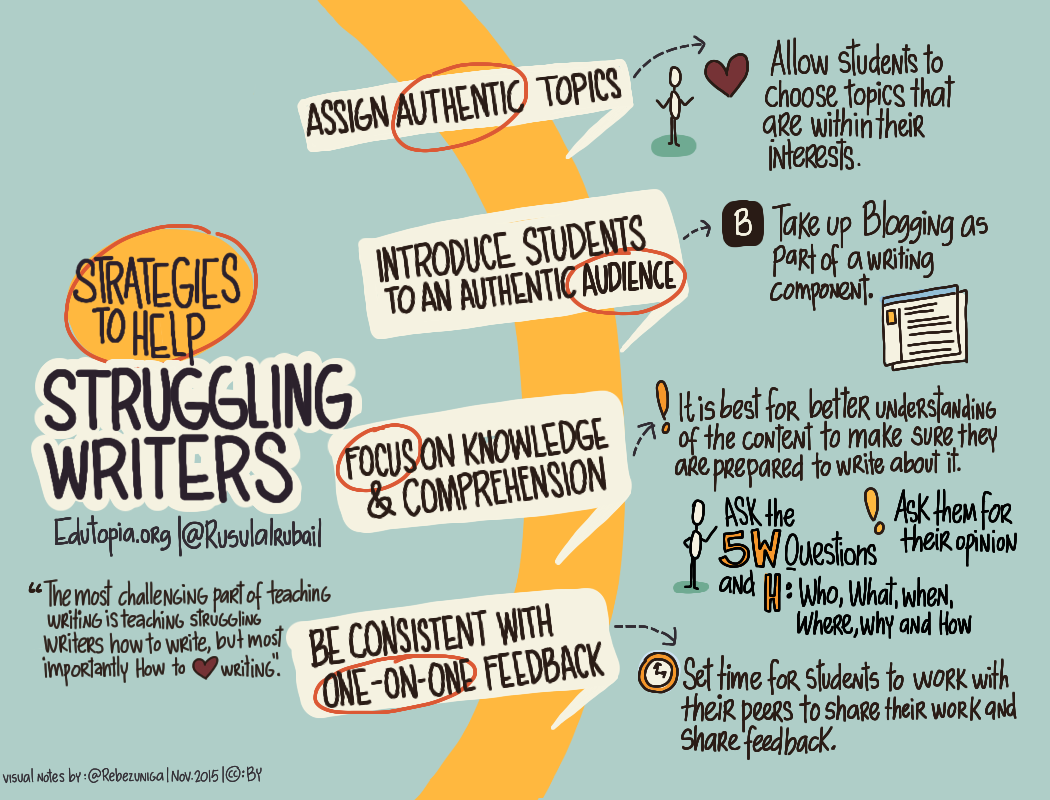
Love this graphic from Edutopia. It gets to the heart of learning experiences that focus on good writing.
HOW AM I GOING TO USE THIS IN REAL LIFE
The Idea Center offers us clear examples of how and why we should make our learning experiences relevant for our students. "There are many reasons for incorporating real-life situations into instruction. Foremost are that applications of theoretical material in real-life situations make content easier to understand, and that the relevance of content is demonstrated by real-life examples. Relevance is a major component of many motivational models (1, 2) and particularly important if learners’ experiences can be used as a basis for new learning. Recent literature on brain function and learning (3, 4) reinforces a constructivist view in which existing knowledge forms the foundation for incorporating new information into more complex and sophisticated schemas. Thus, if prior experience can be connected to new material in a meaningful way, that material can be more clearly understood and more easily learned." Continue reading.
Dr. Maryellen Weimer has posted a terrific message on her blog about critical self-reflection. She writes, "When are you going to retire?” “Why are you still working?” These are questions I’m asked regularly. Worried that the question is motivated by signs of diminished mental acuity, I scour old and new writings looking for evidence. Should I stop working? I wonder. On a recent flight back to State College I sat next to a Penn State student, a junior accounting and finance major. She sounded like one of those students we’re only too happy to have in class. She talked about her courses, projects, assignments she was working on, her teachers, and how excited she was about her chosen fields. “And what do you do?” she asked. “Oh, I work for you,” I replied. “How so?” “Well, I work with college profs on ways to teach that help students learn.” “I’ve had quite a few teachers who could use your help,” she observed. “You know, a good teacher makes such a difference for students. I have this accounting prof who is just fantastic. I leave his class and I am so motivated. I do homework for that class first and I really study for his exams, and not just for the grade; I really want to learn the material.” “What’s his name?” I asked, and when she told me I felt a big smile crossing my face. “I know him! I helped him when he was a brand-new prof.” I didn’t tell her that he wasn’t a very good teacher back then. But I remember his commitment to doing better, his openness to suggestions, and his willingness to learn. And now he’s having this kind of impact on a student! I wish I’d had a glass of wine—a toast seemed so in order." Continue reading.
Love this graphic from Edutopia. It gets to the heart of learning experiences that focus on good writing.
HOW AM I GOING TO USE THIS IN REAL LIFE
The Idea Center offers us clear examples of how and why we should make our learning experiences relevant for our students. "There are many reasons for incorporating real-life situations into instruction. Foremost are that applications of theoretical material in real-life situations make content easier to understand, and that the relevance of content is demonstrated by real-life examples. Relevance is a major component of many motivational models (1, 2) and particularly important if learners’ experiences can be used as a basis for new learning. Recent literature on brain function and learning (3, 4) reinforces a constructivist view in which existing knowledge forms the foundation for incorporating new information into more complex and sophisticated schemas. Thus, if prior experience can be connected to new material in a meaningful way, that material can be more clearly understood and more easily learned." Continue reading.
Wednesday, April 26, 2017

Wednesday, September 7, 2016

Larry Ferlazzo is an educationalist who strongly believes that we should be helping all students become self-regulated learners. In his new book Building a Community of Self-Motivated Learners: Strategies to Help Students Thrive in School and Beyond, he provides research on extrinsic and intrinsic motivation, and describes the four qualities that have been identified as critical to helping students motivate themselves: autonomy, competence, relatedness, and relevance. He says, "A high-quality relationship with a teacher whom they respect is a key element of helping students develop intrinsic motivation." Read more here.
Students who frequently check their grades throughout the semester tend to get better marks than do those who look less often. That’s one of the findings from a new study by Blackboard, a company that sells course-management software to hundreds of colleges. It’s probably one of the deepest data dives ever done on student clicks on college web systems, analyzing aggregate data from 70,000 courses at 927 colleges and universities in North America during the spring 2016 semester. The promise: Big data could lead to insights on how to keep struggling students on track, or at least let professors test their long-held assumptions about student habits. Read more here or listen to the podcast.
Subscribe to:
Posts (Atom)